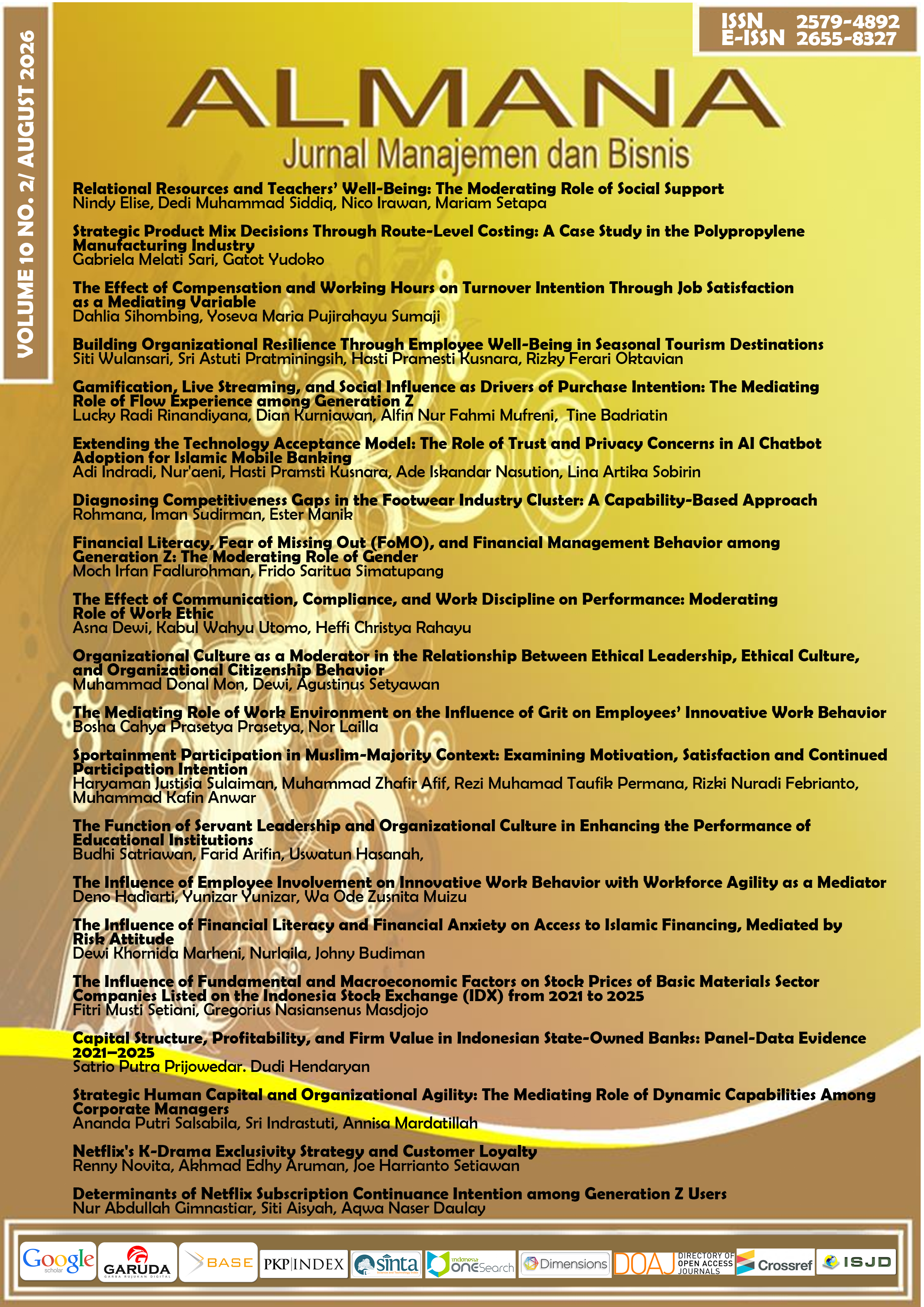
The Influence of Employee Involvement on Innovative Work Behavior with Workforce Agility as a Mediator
DOI:
https://doi.org/10.36555/almana.v10i2.3063Keywords:
Employee Involvement, Innovative Work Behavior, Mediation, Public Sector, Workforce AgilityAbstract
Innovative work behavior has become an essential requirement for public sector organizations in responding to increasingly dynamic workplace changes. However, at the Center for Competency Development of Bina Marga, employees' innovative work behavior has not developed optimally despite their participation in competency development programs. This condition is presumed to be associated with employee involvement and employees' ability to adapt to changes in the workplace. This study aims to examine the relationship between employee involvement and innovative work behavior through workforce agility as a mediating variable. The study employed a quantitative approach using descriptive and explanatory research methods. The research population consisted of 831 training program alumni from the Center for Competency Development of Bina Marga, with the sample selected using proportionate stratified random sampling. Data were analyzed using Partial Least Squares Structural Equation Modeling (PLS-SEM). The results indicate that employee involvement is positively associated with workforce agility, workforce agility is positively associated with innovative work behavior, employee involvement is positively associated with innovative work behavior, and workforce agility significantly mediates the relationship between employee involvement and innovative work behavior. These findings suggest that fostering innovative work behavior is associated with strengthening employee involvement and workforce agility alongside competency development initiatives.
References
AlAbood, A., & Manakkattil MohammedIsmail, S. (2023). Workforce agility, organizational identity and solidarity as antecedents of innovative work behaviour: An examination using structural equation modelling. Benchmarking: An International Journal, 31(10), 3560–3586. https://doi.org/10.1108/BIJ-07-2022-0458
Alqumairah, A. A., & Purba, D. E. (2024). The role of employee involvement and psychological empowerment on employees’ workforce agility at PT. XYZ telecommunication industry: Intervention program “Agile Empower.” International Journal of Science and Society, 6(4), 395–402. https://doi.org/10.54783/ijsoc.v6i4.1341
Alviani, D., Hilmiana, Widianto, S., & Muizu, W. O. Z. (2024). Workforce agility: A systematic literature review and research agenda. Frontiers in Psychology, 15, Article 1376399. https://doi.org/10.3389/fpsyg.2024.1376399
Bakker, A. B., Demerouti, E., & Sanz-Vergel, A. (2023). Job demands–resources theory: Ten years later. Annual Review of Organizational Psychology and Organizational Behavior, 10, 25–53. https://doi.org/10.1146/annurev-orgpsych-120920-053933
Blau, P. M. (1964). Exchange and power in social life. Wiley. https://books.google.com/books?id=Jvq2AAAAIAAJ
Center for Competency Development of Bina Marga. (2024). Post-training monitoring report [Unpublished internal report]. Ministry of Public Works and Housing of the Republic of Indonesia.
Choi, W.-S., Kang, S.-W., & Choi, S. B. (2021). Innovative behavior in the workplace: An empirical study of moderated mediation model of self-efficacy, perceived organizational support, and leader–member exchange. Behavioral Sciences, 11(12), Article 182. https://doi.org/10.3390/bs11120182
Franco, C., & Landini, F. (2022). Organizational drivers of innovation: The role of workforce agility. Research Policy, 51(2), Article 104423. https://doi.org/10.1016/j.respol.2021.104423
Hair, J. F., Black, W. C., Babin, B. J., & Anderson, R. E. (2010). Multivariate data analysis: A global perspective (7th ed.). Pearson. https://books.google.com/books?id=SLRPLgAACAAJ
Heckscher, C. (1994). Defining the post-bureaucratic type. In C. Heckscher & A. Donnellon (Eds.), The post-bureaucratic organization: New perspectives on organizational change (pp. 14–62). SAGE Publications. https://openlibrary.org/books/OL7908706M
Janssen, O. (2000). Job demands, perceptions of effort–reward fairness and innovative work behaviour. Journal of Occupational and Organizational Psychology, 73(3), 287–302. https://doi.org/10.1348/096317900167038
Mohamad, A. A. (2024). The impact of workforce agile behavior on organizational innovation performance for manufacturing enterprises. In K. Al Marri, F. A. Mir, S. A. David, & M. Al-Emran (Eds.), BUiD Doctoral Research Conference 2023 (Lecture Notes in Civil Engineering, Vol. 473, pp. 396–404). Springer. https://doi.org/10.1007/978-3-031-56121-4_37
Natapoera, M. P., & Mangundjaya, W. L. (2020). The effect of employee involvement and work engagement on workforce agility. In Proceedings of the 3rd International Conference on Administrative Science, Policy, and Governance Studies (ICAS-PGS 2019). EAI. https://doi.org/10.4108/eai.30-10-2019.2299408
Petermann, M. K. H., & Zacher, H. (2022). Workforce agility: Development and validation of a multidimensional measure. Frontiers in Psychology, 13, Article 841862. https://doi.org/10.3389/fpsyg.2022.841862
Scott, S. G., & Bruce, R. A. (1994). Determinants of innovative behavior: A path model of individual innovation in the workplace. Academy of Management Journal, 37(3), 580–607. https://doi.org/10.5465/256701
Sherehiy, B., & Karwowski, W. (2014). The relationship between work organization and workforce agility in small manufacturing enterprises. International Journal of Industrial Ergonomics, 44(3), 466–473. https://doi.org/10.1016/j.ergon.2014.01.002
Sumukadas, N., & Sawhney, R. (2004). Workforce agility through employee involvement. IIE Transactions, 36(10), 1011–1021. https://doi.org/10.1080/07408170490500997
West, M. A., & Farr, J. L. (Eds.). (1990). Innovation and creativity at work: Psychological and organizational strategies. Wiley. https://archive.org/details/innovationcreati0000unse
Downloads
Published
How to Cite
Issue
Section
Citation Check
License
Copyright (c) 2026 Almana : Jurnal Manajemen dan Bisnis

This work is licensed under a Creative Commons Attribution-NonCommercial-NoDerivatives 4.0 International License.