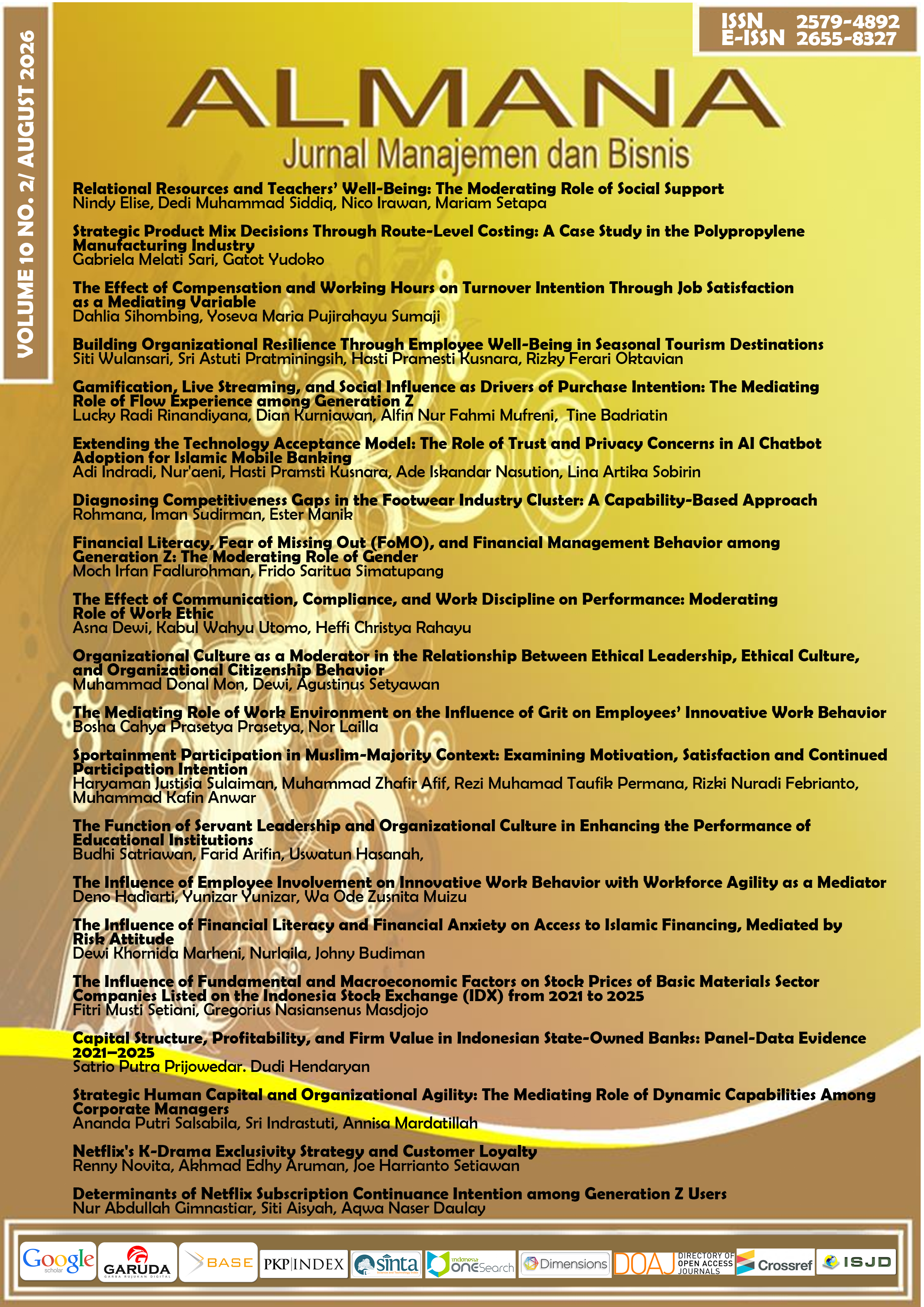
Strategic Human Capital and Organizational Agility: The Mediating Role of Dynamic Capabilities Among Corporate Managers
DOI:
https://doi.org/10.36555/almana.v10i2.3070Keywords:
Dynamic Capabilities, Organizational Agility, Strategic Human CapitalAbstract
In an increasingly dynamic and uncertain business environment, organizations require strategic capabilities to respond effectively to technological, market, and competitive changes. This study examines the relationships between Strategic Human Capital (SHC), Dynamic Capabilities (DC), and Organizational Agility (OA), with particular attention to the mediating role of DC among corporate managers in Riau Province, Indonesia. A quantitative cross-sectional survey was conducted involving 250 corporate managers from various industrial sectors. Data were analyzed using Partial Least Squares Structural Equation Modeling (PLS-SEM) with 5,000 bootstrap subsamples. The results indicate positive and significant relationships between SHC and DC (β = 0.765, p < 0.001), SHC and OA (β = 0.325, p < 0.001), and DC and OA (β = 0.582, p < 0.001). The model explains 58.5% of the variance in DC and 67.5% of the variance in OA. These findings indicate that strategic human capital is associated with organizational agility both directly and through the development of dynamic capabilities. The study contributes to the Resource-Based View and Dynamic Capability Theory by explaining the role of dynamic capabilities in linking strategic human capital with organizational agility in a rapidly changing business environment.
References
AlNuaimi, B. K., Kumar Singh, S., Ren, S., Budhwar, P., & Vorobyev, D. (2022). Mastering digital transformation: The nexus between leadership, agility, and digital strategy. Journal of Business Research, 145, 636–648. https://doi.org/10.1016/j.jbusres.2022.03.038
Badan Pusat Statistik Provinsi Riau. (2025). Provinsi Riau dalam angka 2025. https://riau.bps.go.id
Bamel, U. K., Pereira, V., Del Giudice, M., & Temouri, Y. (2022). The relationship between human capital and organizational performance: The mediating role of knowledge management capability. Journal of Knowledge Management, 26(5), 1145–1167. https://doi.org/10.1108/JKM-05-2021-0390
Barney, J. B. (1991). Firm resources and sustained competitive advantage. Journal of Management, 17(1), 99–120. https://doi.org/10.1177/014920639101700108
Barney, J. B. (2021). The emergence of resource-based theory: A personal journey. Journal of Management, 47(7), 1663–1676. https://doi.org/10.1177/01492063211015272
Becker, G. S. (1964). Human capital: A theoretical and empirical analysis, with special reference to education. University of Chicago Press.
Durán, W. F., Aguado, D., & Perdomo-Ortiz, J. (2023). Relationship between CEO’s strategic human capital and dynamic capabilities: A meta-analysis. Management Review Quarterly, 73, 1631–1666. https://doi.org/10.1007/s11301-022-00282-9
Hair, J. F., Hult, G. T. M., Ringle, C. M., Sarstedt, M., Danks, N. P., & Ray, S. (2021). Partial least squares structural equation modeling (PLS-SEM) using R: A workbook. Springer. https://doi.org/10.1007/978-3-030-80519-7
Helfat, C. E. (2022). Strategic organization, dynamic capabilities, and the external environment. Strategic Organization, 20(4), 734–742. https://doi.org/10.1177/14761270221115377
Hughes, M., Cesinger, B., Cheng, C. F., Schuessler, F., & Kraus, S. (2022). A configurational analysis of network and knowledge variables explaining born globals’ and late internationalizing SMEs’ international performance. Industrial Marketing Management, 80, 172–187.
Mikalef, P., & Gupta, M. (2021). Artificial intelligence capability: Conceptualization, measurement calibration, and empirical study on its impact on organizational creativity and firm performance. Information & Management, 58(3), 103434. https://doi.org/10.1016/j.im.2021.103434
Ployhart, R. E., Nyberg, A. J., Reilly, G., & Maltarich, M. A. (2021). Human capital is dead; long live human capital resources! Journal of Management, 47(7), 1795–1820. https://doi.org/10.1177/0149206321991936
Roundtable on Sustainable Palm Oil. (2024). 2024 RSPO principles and criteria: For the production of sustainable palm oil. https://rspo.org/resources/
Schilke, O., Hu, S., & Helfat, C. E. (2018). Quo vadis, dynamic capabilities? A content-analytic review of the current state of knowledge and recommendations for future research. Academy of Management Annals, 12(1), 390–439. https://doi.org/10.5465/annals.2016.0014
Teece, D. J., Peteraf, M. A., & Leih, S. (2016). Dynamic capabilities and organizational agility: Risk, uncertainty, and strategy in the innovation economy. California Management Review, 58(4), 13–35. https://doi.org/10.1525/cmr.2016.58.4.13
Teece, D. J., Pisano, G., & Shuen, A. (1997). Dynamic capabilities and strategic management. Strategic Management Journal, 18(7), 509–533. https://doi.org/10.1002/(SICI)1097-0266(199708)18:7<509::AID-SMJ882>3.0.CO;2-Z
Vial, G. (2021). Understanding digital transformation: A review and a research agenda. The Journal of Strategic Information Systems, 30(2), 101675. https://doi.org/10.1016/j.jsis.2021.101675
Walter, A.-T., & Raetze, S. (2021). Toward a process-oriented model of organizational agility: a dynamic capability perspective. Journal of Competences, Strategy & Management, 11, 1–20. https://doi.org/10.25437/jcsm-vol11-22
Warner, K. S. R., & Wäger, M. (2019). Building dynamic capabilities for digital transformation: An ongoing process of strategic renewal. Long Range Planning, 52(3), 326–349. https://doi.org/10.1016/j.lrp.2018.12.001
Downloads
Published
How to Cite
Issue
Section
Citation Check
License
Copyright (c) 2026 Almana : Jurnal Manajemen dan Bisnis

This work is licensed under a Creative Commons Attribution-NonCommercial-NoDerivatives 4.0 International License.