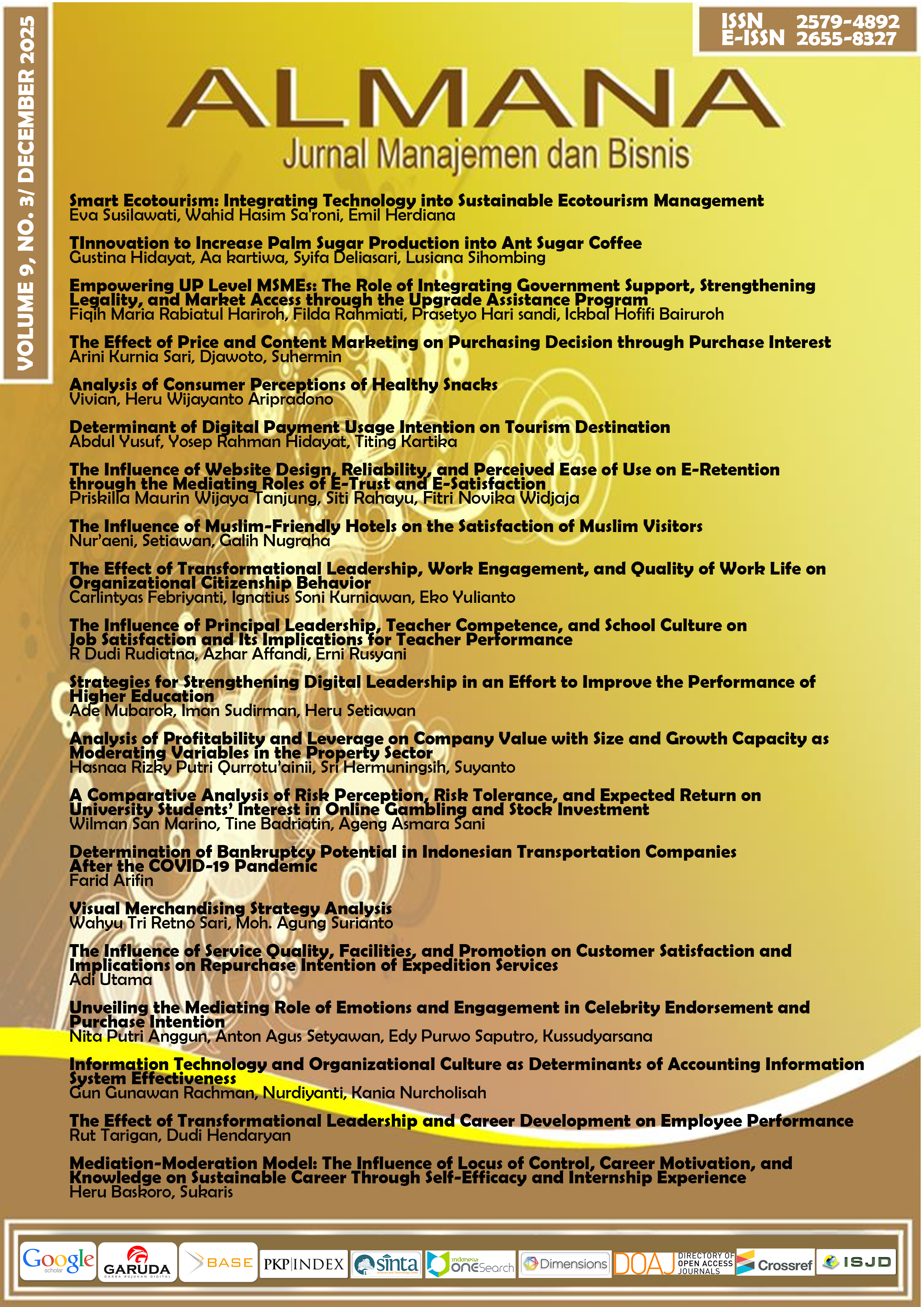
Smart Ecotourism: Integrating Technology into Sustainable Ecotourism Management
DOI:
https://doi.org/10.36555/almana.v9i3.2914Keywords:
Ecotourism Management, Environmental Sustainability, Smart Ecotourism, TechnologyAbstract
This research is motivated by the challenges of ecotourism management in West Java, which despite its great potential, still faces problems of ecosystem degradation and suboptimal destination management. This study aims to develop a technology-based smart ecotourism model by integrating environmental, social, and economic aspects simultaneously, as a novelty from previous studies that generally only emphasize one aspect of management. The method used is a quantitative approach through a survey of 150 respondents consisting of ecotourism managers, tourists, and local communities in several leading destinations in West Java. Data were collected using a 1-5 Likert scale questionnaire and analyzed using validity and reliability tests, multiple linear regression, and path analysis with the help of SPSS 22. The results showed that the use of technology has a positive and significant effect on ecotourism sustainability (R² = 0.801, p < 0.05), but does not have a significant effect on the socio-economic impacts of the community, and ecotourism sustainability was not proven to mediate the relationship. The research conclusion emphasizes that technology integration needs to be accompanied by community empowerment programs to make socio-economic benefits more tangible, with recommendations in the form of increasing digital literacy, developing community-based platforms, and regional policies that support technology synergy and local welfare.
References
Alhaddi, H. (2019). A contemporary interpretation of the Triple Bottom Line and its relevance to sustainability. Journal of Business Ethics and Sustainability, 8(1), 45-58.
Amini, R., & Rustiana, D. (2020). Triple Bottom Line framework in sustainable tourism development. Journal of Sustainable Development Studies, 12(2), 55-68.
Buhalis, D., & Sinarta, Y. (2022). Smart tourism transformation and community readiness. Tourism Management, 91, 104534.
Dewi, M., Sari, A., & Putra, R. (2019). Mobile-based digital applications for ecotourism interpretation. Tourism Innovation Journal, 11(3), 200-215.
Gössling, S., & Hall, C. M. (2019). Tourism, resilience, and sustainable development. Journal of Sustainable Tourism, 27(7), 1075-1092.
Gretzel, U., Koo, C., & Lee, J. (2021). Smart tourism ecosystems and destination resilience. Journal of Destination Marketing & Management, 20, 100622.
Hartono, L., Syahputra, D., & Anwar, S. (2020). GIS-based ecotourism mapping for conservation planning. Geospatial Journal, 9(1), 33-48.
Kurniawan, T., Hasan, M., & Sutopo, D. (2022). Digital empowerment and technology adoption in community-based tourism. Journal of Sustainable Tourism Research, 18(1), 55-70.
Li, J., Pearce, P. L., & Low, D. (2021). AI applications in digital tourism environments. Tourism Management, 83, 104248.
Nugraha, B., Lestari, F., & Widodo, R. (2021). Sustainable ecotourism management and community welfare in West Java. Indonesian Tourism Journal, 10(2), 45-60.
Rahman, A. (2023). Blockchain and AI integration for sustainable ecotourism management. Journal of Ecotourism and Technology, 5(4), 99-113.
Rahmawati, I., & Nurlatifah, E. (2022). Digital literacy barriers in rural tourism communities. Journal of Tourism and Technology, 14(2), 112-124.
Setiawan, R. (2020). Digital transformation and community participation in smart tourism. Tourism Research Journal, 15(3), 102-118.
UNWTO. (2022). Sustainable tourism development: A global perspective. United Nations World Tourism Organization.
Widodo, S., Pranata, H., & Kusuma, A. (2019). IoT-based environmental monitoring for natural tourism destinations. Journal of Environmental Science, 12(4), 78-90.
Downloads
Published
How to Cite
Issue
Section
Citation Check
License
Copyright (c) 2025 Almana : Jurnal Manajemen dan Bisnis

This work is licensed under a Creative Commons Attribution-NonCommercial-NoDerivatives 4.0 International License.