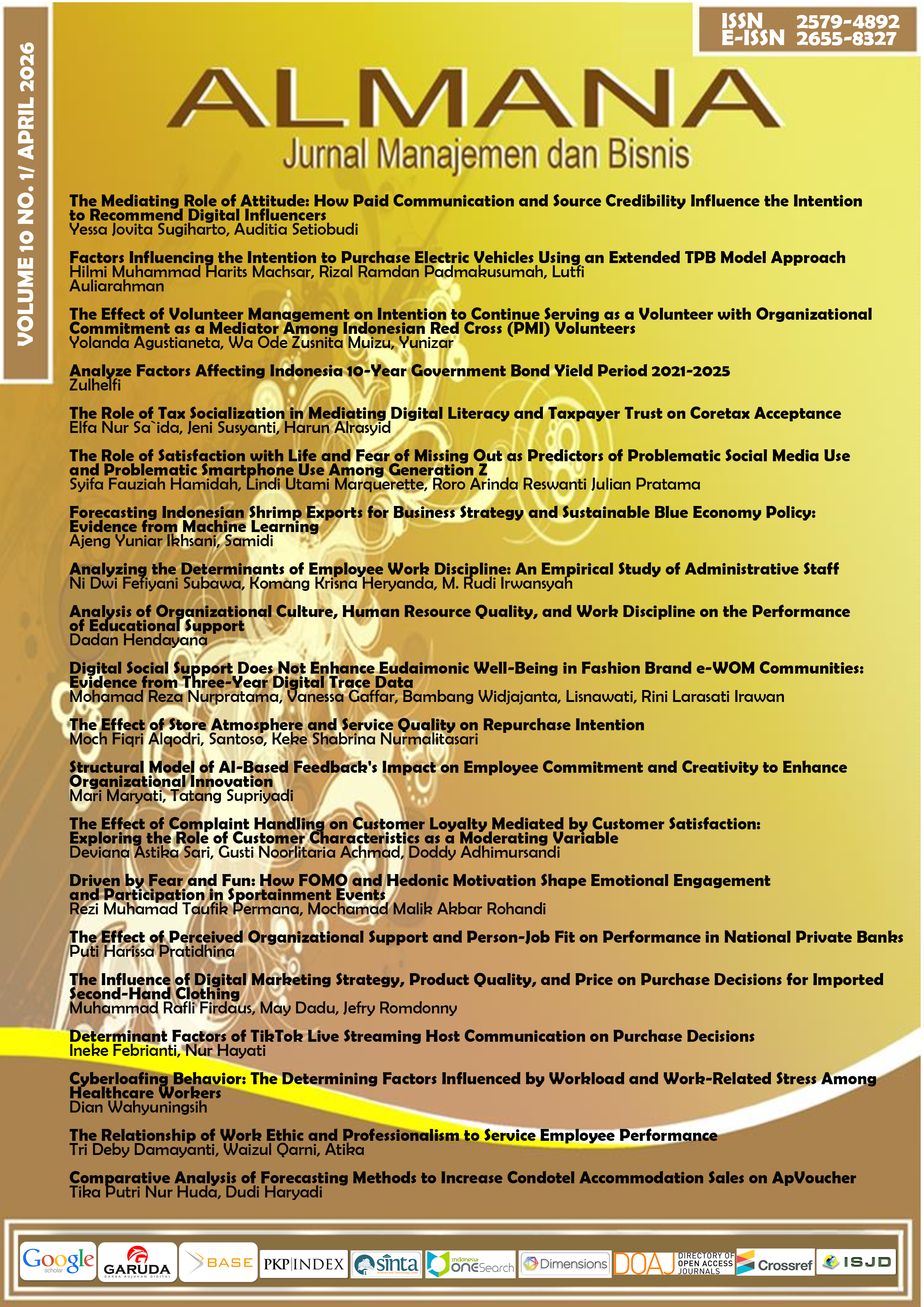
Driven by Fear and Fun: How FOMO and Hedonic Motivation Shape Emotional Engagement and Participation in Sportainment Events
DOI:
https://doi.org/10.36555/almana.v10i1.3020Keywords:
Continued participation intention, Emotional Engagement , FOMO, Hedonic Motivation , Sportainment EventsAbstract
This study investigates the roles of Fear of Missing Out (FOMO) and hedonic motivation as antecedents of emotional engagement and continued participation intention in sportainment events. Unlike prior studies that examine these constructs in isolation or in Western metropolitan contexts, this research integrates both psychological drivers within a single affective mediation framework applied to an emerging Indonesian urban setting. A quantitative, cross‑sectional survey of 150 urban sportainment participants in Bandung was conducted using a structured Likert-scale questionnaire and analyzed via partial least squares structural equation modeling (PLS-SEM). Both FOMO and hedonic motivation positively and significantly influence emotional engagement, with hedonic motivation exhibiting a stronger effect. Emotional engagement, in turn, significantly predicts continued participation intention and fully mediates both antecedent effects. These findings reveal that while FOMO generates social momentum for attendance, hedonic experience quality is the principal driver of sustained emotional involvement and re-attendance and re-engagement. The results offer theoretically grounded and practically actionable insights for event designers and marketers in emerging urban markets.
References
Ajzen, I. (1991). The theory of planned behavior. Organizational Behavior and Human Decision Processes, 50(2), 179–211. https://doi.org/10.1016/0749-5978(91)90020-T
Akbari, M., Seydavi, M., Palmieri, S., Mansueto, G., Caselli, G., & Spada, M. M. (2021). Fear of missing out (FoMO) and internet use: A comprehensive systematic review and meta‑analysis. Journal of Behavioral Addictions. https://doi.org/10.1556/2006.2021.00083
Bank Indonesia Jawa Barat. (2025). Bandung QRIS Run 2025. https://doi.org/10.13140/RG.2.2.12345.67890
Barrett, J. A. M., Jaakkola, E., Heller, J., Brüggen, E. C., & others. (2025). Customer engagement in utilitarian vs. hedonic service contexts. Journal of Service Research, 28(1), 3–22. https://doi.org/10.1177/10946705241242901
Bettiga, D., Yacout, O., & Noci, G. (2023). Emotions as key drivers of consumer behaviors: A multidisciplinary perspective. Frontiers in Communication, 8, 1158942. https://doi.org/10.3389/fcomm.2023.1158942
Brodie, R. J., Hollebeek, L. D., Juric, B., & Ilic, A. (2011). Customer engagement: Conceptual domain, fundamental propositions, and implications for research. Journal of Service Research, 14(3), 252–271. https://doi.org/10.1177/1094670511411703
Buglass, S. L., Binder, J. F., & Betts, L. R. (2021). Motivators of online vulnerability: The impact of social exclusion and FoMO. Computers in Human Behavior, 114, 106554. https://doi.org/10.1016/j.chb.2020.106554
Getz, D. (2018). Event studies: Theory, research and policy for planned events (3rd ed.). Routledge.
Gioia, F., Fioravanti, G., Casale, S., & Boursier, V. (2021). The effects of the fear of missing out on people’s social networking sites use during the COVID‑19 pandemic. Frontiers in Psychiatry, 12, Article 620442. https://doi.org/10.3389/fpsyt.2021.620442
Hair, J. F., Hult, G. T. M., Ringle, C., & Sarstedt, M. (2019). A primer on partial least squares structural equation modeling (PLS‑SEM) (2nd ed.). SAGE Publications.
He, B., Tan, Z., Lai, K., Qiu, B., & Wang, S. (2024). The effect of event impact on fear of missing out: The chain mediation effect of coping styles and anxiety. Frontiers in Psychology, 15, Article 1382440. https://doi.org/10.3389/fpsyg.2024.1382440
Hollebeek, L. D. (2014). Engagement: A customer‑dominant logic perspective. Journal of Service Management, 25(2), 155–169. https://doi.org/10.1108/JOSM-07-2013-0177 (doi.org in Bing)
Jabeen, F., Tandon, A., Sithipolvanichgul, J., Srivastava, S., & Dhir, A. (2023). Social media-induced fear of missing out (FoMO) and social media fatigue: The role of narcissism, comparison and disclosure. Journal of Business Research, 159, Article 113693. https://doi.org/10.1016/j.jbusres.2023.113693
Lianopoulos, Y., Kotsi, N., Karagiorgos, T., & Theodorakis, N. D. (2024). Experiential effects on mass sport participants’ event satisfaction and behavioral intentions: Examining sensory, affective, behavioral, intellectual and relational dimensions. International Journal of Event and Festival Management, 15(2), 270–292. https://doi.org/10.1108/IJEFM-09-2023-0075
Lim, W. M., & Rasul, T. (2022). Customer engagement and social media: Revisiting the past to inform the future. Journal of Business Research, 148, 325–342. https://doi.org/10.1016/j.jbusres.2022.04.068
Nuryana, A., Cahyono, D., Centeury, M. T. R., Mahmudin, T., & Heriyanto, H. (2023). Sportainment And Sport Tourism Strategy In The Development Of Indonesian Tourism During The 2023 U-17 World Cup Event . Innovative: Journal Of Social Science Research, 3(6), 5055–5066.
Moghaddam, M., Kristiansen, E., & Opstad, B. (2024). Enhancing consumer participation in the context of sport events: The power of three basic psychological needs. Journal of Convention & Event Tourism, 25(4), 259–281. https://doi.org/10.1080/15470148.2024.2339209
Oliver, R. L. (1999). Whence consumer loyalty? Journal of Marketing, 63(Special Issue), 33–44. https://doi.org/10.1177/00222429990634s105
Peric, Marko (2015). Managing sports experiences in the context of tourism, UTMS Journal of Economics, ISSN 1857-6982, University of Tourism and Management, Skopje, Vol. 6, Iss. 1, pp. 85-97. : https://hdl.handle.net/10419/146295
Pine, B. J., & Gilmore, J. H. (1999). The experience economy: Work is theatre & every business a stage. Harvard Business School Press.
Przybylski, A. K., Murayama, K., DeHaan, C. R., & Gladwell, V. (2013). Motivational, emotional, and behavioral correlates of fear of missing out. Computers in Human Behavior, 29(4), 1841–1848. https://doi.org/10.1016/j.chb.2013.02.014
Ryan, R. M., & Deci, E. L. (2000). Intrinsic and extrinsic motivations: Classic definitions and new directions. Contemporary Educational Psychology, 25(1), 54–67. https://doi.org/10.1006/ceps.1999.1020
Sevimliş, A., Doğan, M., Gálvez-Ruiz, P., & García-Fernández, J. (2024). Dimensions and outcomes of experiential quality in the fitness industry: The case of Turkey. International Journal of Sports Marketing and Sponsorship, 25(2), 396–418. https://doi.org/10.1108/IJSMS-06-2023-0130
Stults-Kolehmainen, M. A., et al. (2023). Editorial: Motivation states and hedonic motivation for physical activity. Frontiers in Sports and Active Living. https://doi.org/10.3389/fspor.2023.1282118
Tandon, A., Dhir, A., Almugren, I., AlNemer, H. A., & Mäntymäki, M. (2021). Fear of missing out (FoMO) among social media users: A systematic literature review, synthesis and framework for future research. Internet Research, 31(3), 782–821. https://doi.org/10.1108/INTR-11-2019-0455
Venkatesh, V., Thong, J. Y. L., & Xu, X. (2012). Consumer acceptance and use of information technology: Extending UTAUT. MIS Quarterly, 36(1), 157–178. https://doi.org/10.2307/41410412
Downloads
Published
How to Cite
Issue
Section
Citation Check
License
Copyright (c) 2026 Almana : Jurnal Manajemen dan Bisnis

This work is licensed under a Creative Commons Attribution-NonCommercial-NoDerivatives 4.0 International License.