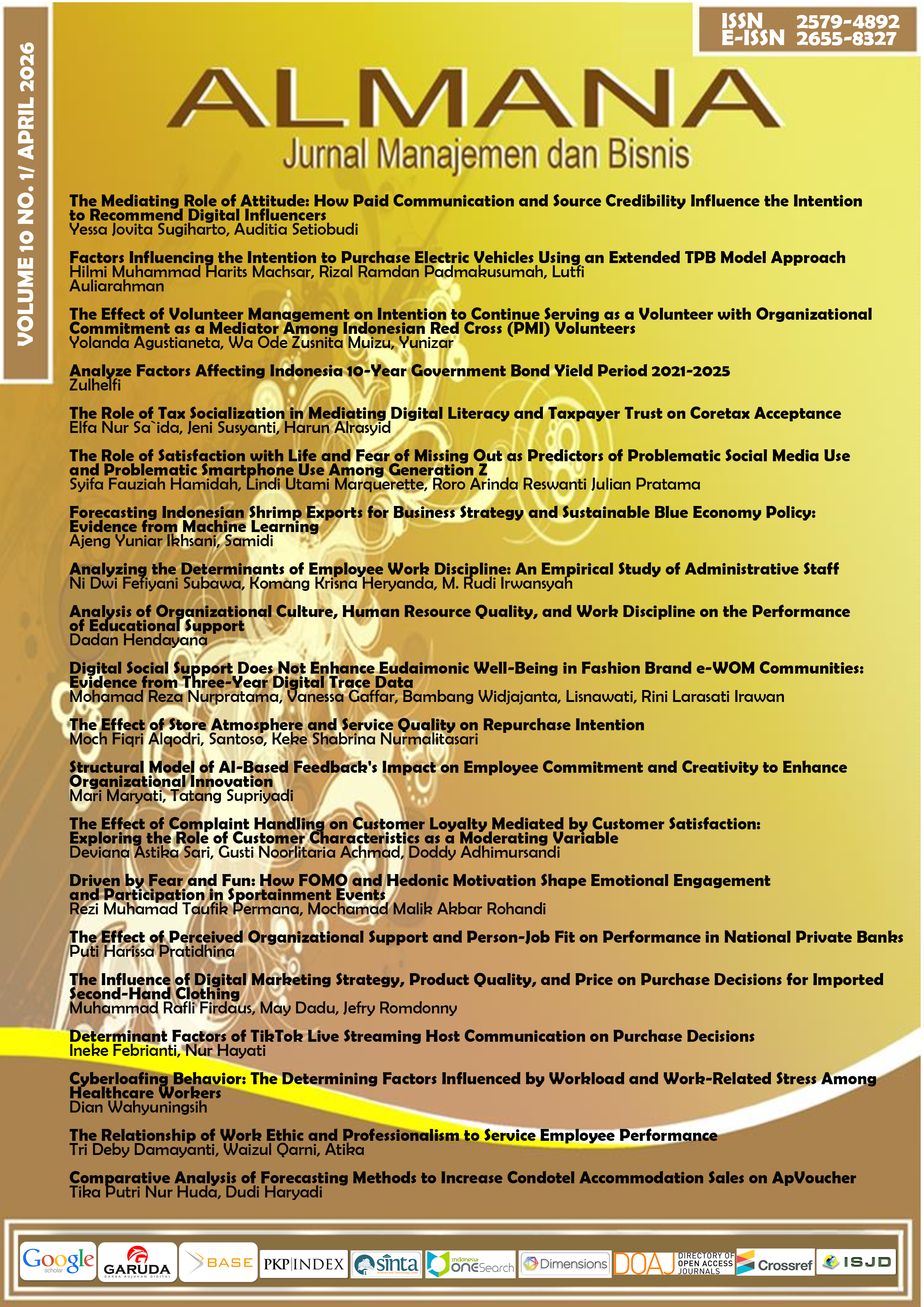
Digital Social Support Does Not Enhance Eudaimonic Well-Being in Fashion Brand e-WOM Communities: Evidence from Three-Year Digital Trace Data
DOI:
https://doi.org/10.36555/almana.v10i1.3005Keywords:
Digital social support, Digital trace data, Eudaimonic well-being, e-WOM, Fashion continuityAbstract
This study examines whether digital social support (DSS) in fashion brand electronic word-of-mouth (e-WOM) communities influences consumers’ eudaimonic well-being (EWB). Grounded in Self-Determination Theory and Social Support Theory, the study positions meaning orientation (MO) as a mediator and online toxicity (OT) as a moderator. Digital trace data from 400 active consumers comprising 20,134 comments across three platforms (YouTube, Reddit, and X/Twitter) over the period January 2023–December 2025 were analyzed using SEM-PLS (SmartPLS). Results indicate that DSS does not significantly affect EWB either directly or through MO. The moderating effect of online toxicity is also non-significant. These findings suggest that social support within fast fashion consumption spaces does not automatically translate into meaningful psychological well-being. This study contributes by identifying a boundary condition in the digital social support and well-being literature within commercial contexts.
References
Amado, M., Guzmán, A., & Juarez, F. (2023). Relationship between perceived value, student experience, and university reputation: structural equation modeling. Humanities and Social Sciences Communications, 10(1), 1–13. https://doi.org/10.1057/s41599-023-02272-y
Asanprakit, S., & Kraiwanit, T. (2024). Multiplier transformation of E-commerce to S-commerce in emerging economy. R-Economy, 10(1), 55–73. https://doi.org/10.15826/recon.2024.10.1.004
Aurèle, M., & Damir, D. (2024). StockTwits classified sentiment and stock returns. In Digital Finance (Vol. 6, Issue 2). Springer International Publishing. https://doi.org/10.1007/s42521-023-00102-z
Benevento, E., Aloini, D., Roma, P., & Bellino, D. (2025). The impact of influencers on brand social network growth : Insights from new product launch events on Twitter. Journal of Business Research, 189(November 2024), 115123. https://doi.org/10.1016/j.jbusres.2024.115123
Bharej, M. K., & Singh, N. (2025). Electronic Word of Mouth ( eWOM ) And Its Impact on Consumer Buying Behaviour. 10, 1154–1175.
Bui, C. T., Thuy, T., & Ngo, A. (2025). How perceived eWOM in visual form influences online purchase intention on social media : A research based on the SOR theory. 1–33. https://doi.org/10.1371/journal.pone.0328093
Bui, T. N., Nguyen, X. H., & Pham, K. T. (2023). The Effect of Capital Structure on Firm Value: A Study of Companies Listed on the Vietnamese Stock Market. International Journal of Financial Studies, 11(3). https://doi.org/10.3390/ijfs11030100
Chen, X., Xie, H., Li, Z., Zhang, H., Tao, X., & Lee, F. (2025). Sentiment analysis for stock market research : A bibliometric study $. Natural Language Processing Journal, 10(July 2023), 100125. https://doi.org/10.1016/j.nlp.2025.100125
D.Ryff, C. (1989). Happiness is everything, or is it? Explorations on the meaning of Psychological Well-Being. Journal of Personality and Social Psychology, 57(6), 1069–1081. http://coursedelivery.org/write/wp-content/uploads/2015/02/2-Happiness-is-everything-or-is-it.pdf
Deng, Y., Shen, H., & Ji, X. (2024). Exploring Virtual Fashion Consumption through the Emotional Three-Level Theory : Reflections on Sustainable Consumer Behavior.
Fithriyana, I., Maria, S., & Hidayati, T. (2022). The Relationship between Employee Satisfaction and Employee Performance mediated by Employee Engagement. Frontiers in Business and Economics, 1(3), 147–153. https://doi.org/10.56225/finbe.v1i3.120
Godard, R., & Holtzman, S. (2024). Are active and passive social media use related to mental health , wellbeing , and social support outcomes ? A meta-analysis of 141 studies. October 2023.
Gummer, T., Schwalbach, J., & Silber, H. (2025). Assessing Data Quality in the Age of Digital Social Research : A Systematic Review (Vol. 43, Issue 5). https://doi.org/10.1177/08944393241245395
Guo, K., Wang, Z., Li, C., & Guo, C. (2023). Meaningful Sports Consumption Behavior Influences the Production of Individual Eudaimonic Well-Being: The Chain-Mediated Role of Perceived Social Support and Perceived Self-Esteem. Sustainability (Switzerland), 15(19). https://doi.org/10.3390/su151914043
Hair, J. F., Babin, B. J., Ringle, C. M., Sarstedt, M., & Becker, J. M. (2025). Covariance ‑ based structural equation modeling ( CB ‑ SEM ): a SmartPLS 4 software tutorial. Journal of Marketing Analytics, 13(3), 709–724. https://doi.org/10.1057/s41270-025-00414-6
Huta, V., & Waterman, A. S. (2014). Eudaimonia and Its Distinction from Hedonia: Developing a Classification and Terminology for Understanding Conceptual and Operational Definitions. Journal of Happiness Studies, 15(6), 1425–1456. https://doi.org/10.1007/s10902-013-9485-0
Jayawardhena, C. (2021). The Impact of Electronic Word-of-Mouth (eWOM) on Consumer Behaviours. 136–158.
Joshanloo, M. (2024). Eudaimonic Well-Being as a Moderator of the Relationship between Depressive Symptoms and Life Abstract : 1–8. https://doi.org/10.2174/0118743501298966240516055209
Khan, Z., Khan, A., Arwab, M., & Khanam, Z. (2025). Sustainable fashion trends and purchasing pattern analysis for textiles and apparel : An encouragement for eco-innovation. Sustainable Futures, 9(May 2024), 100643. https://doi.org/10.1016/j.sftr.2025.100643
Kinoshita, K., & Sato, S. (2024). Conceptualisation, measurement, and associated factors of eudaimonic well-being of athletes: a systematic review. Taylor and Francis, 22(8).
Lasser, J., Herderich, A., & Garland, J. (2025). Collective moderation of hate , toxicity , and extremity. PNAS Nexus, 4(11), 1–12. https://doi.org/10.1093/pnasnexus/pgaf369
Lengieza, M. L. (2024). Eudaimonic self-expansion : The effects of eudaimonic reflections on nature connectedness. Journal of Environmental Psychology, 94(August 2023), 102231. https://doi.org/10.1016/j.jenvp.2024.102231
Li, H., Wang, Q., & Wu, Y. (2025). From Mobile Media to Generative AI : The Evolutionary Logic of Computational Social Science Across Data , Methods , and Theory. 1–17.
Liu, H., Jayawardhena, C., Shukla, P., & Osburg, V. (2024). Electronic word of mouth 2 . 0 ( eWOM 2 . 0 ) – The evolution of eWOM research in the new age. Journal of Business Research, 176(January), 114587. https://doi.org/10.1016/j.jbusres.2024.114587
Mina, J., Ha, L. S., & Incheol, C. (2024). Unraveling the Most Important Predictors of Eudaimonic and Hedonic Well-Being in Korean Adults : A Machine Learning Approach. 1–22.
Palazzeschi, L., & Bonfiglio, A. (2023). Hedonic and eudaimonic well-being for sustainable development in university students : personality traits or acceptance of change ? May, 1–8. https://doi.org/10.3389/fpsyg.2023.1180995
Park, C. (2022). Social support and psychological well-being in younger and older adults : The mediating effects of basic psychological need satisfaction. November, 1–14. https://doi.org/10.3389/fpsyg.2022.1051968
Park, J., & Chun, J. (2025). The consumer socialization process : How social media affects youth luxury consumption The consumer socialization process : How social media affects youth luxury consumption. Journal of Global Fashion Marketing, 16(2), 156–172. https://doi.org/10.1080/20932685.2024.2434870
Rajkumar, R. P. (2023). Cultural values and changes in happiness in 78 countries during the COVID-19 pandemic: An analysis of data from the World Happiness Reports. Frontiers in Psychology, 14(February). https://doi.org/10.3389/fpsyg.2023.1090340
Ribeiro, H., Valente, K., Santana, D. S., & Oliver, S. L. (2024). Natural Environments in University Campuses and Students ’.
Ryff, C. D. (2024). Contributions of Eudaimonic Well-Being to Mental Health Practice. 27(4), 276–293. https://doi.org/10.1108/mhsi-12-2022-0091.Contributions
Septian, W., Hasnawati, S., & Hendrawaty, E. (2022). Impact of Behavioral Factors among Indonesian Individual Investor towards Investment Decisions during Covid-19 Pandemic. IOSR Journal of Economics and Finance, 13(February), 43–52. https://doi.org/10.9790/5933-1301044352
Shihy, D. El, & Awaad, S. (2025). Leveraging social media for sustainable fashion : how brand and user ‑ generated content influence Gen Z ’ s purchase intentions. Future Business Journal, 3. https://doi.org/10.1186/s43093-025-00529-3
Tafesse, W., Aguilar, M. P., & Sayed, S. (2024). Digital Overload , Coping Mechanisms , and Student Engagement : An Empirical Investigation Based on the S-O-R Framework. March, 1–14. https://doi.org/10.1177/21582440241236087
Tarisa, & Windya, G. R. R. (2024). Pengaruh social media marketing, brand equity, dan brand experience terhadap brand loyalty pada Indomie. Jurnal Manajemen Bisnis Dan Kewirausahaan, 8(4), 769–778. https://doi.org/10.24912/jmbk.v8i4.31622
Thongsri, N., Seksan, J., & Warintarawej, P. (2024). Factors Affecting the Happiness of Learners in Higher Education: Attitude, Grade Point Average, and Time Management. Sustainability (Switzerland), 16(18). https://doi.org/10.3390/su16188214
Valkenburg, P. M. (2022). Social Media Use and Well-Being : What we Know and What we Need to Know ScienceDirect Social media use and well-being : What we know and what we need to know. December 2021. https://doi.org/10.1016/j.copsyc.2021.12.006
Warganegara, D. L., & Hendijani, R. B. (2022). Factors That Drive Actual Purchasing of Groceries through E-Commerce Platforms during COVID-19 in Indonesia. Sustainability (Switzerland), 14(6), 1–21. https://doi.org/10.3390/su14063235
Zhang, C., Tang, L., & Liu, Z. (2023). How social media usage affects psychological and subjective well ‑ being : testing a moderated mediation model. BMC Psychology, 1–20. https://doi.org/10.1186/s40359-023-01311-2
Zhang, Z., Tong, J., & He, Z. (2025). Relationship between physical activity and eudaimonic well-being in college students based on Ryff ’ s six-factor model of psychological well-being.
Downloads
Published
How to Cite
Issue
Section
Citation Check
License
Copyright (c) 2026 Almana : Jurnal Manajemen dan Bisnis

This work is licensed under a Creative Commons Attribution-NonCommercial-NoDerivatives 4.0 International License.