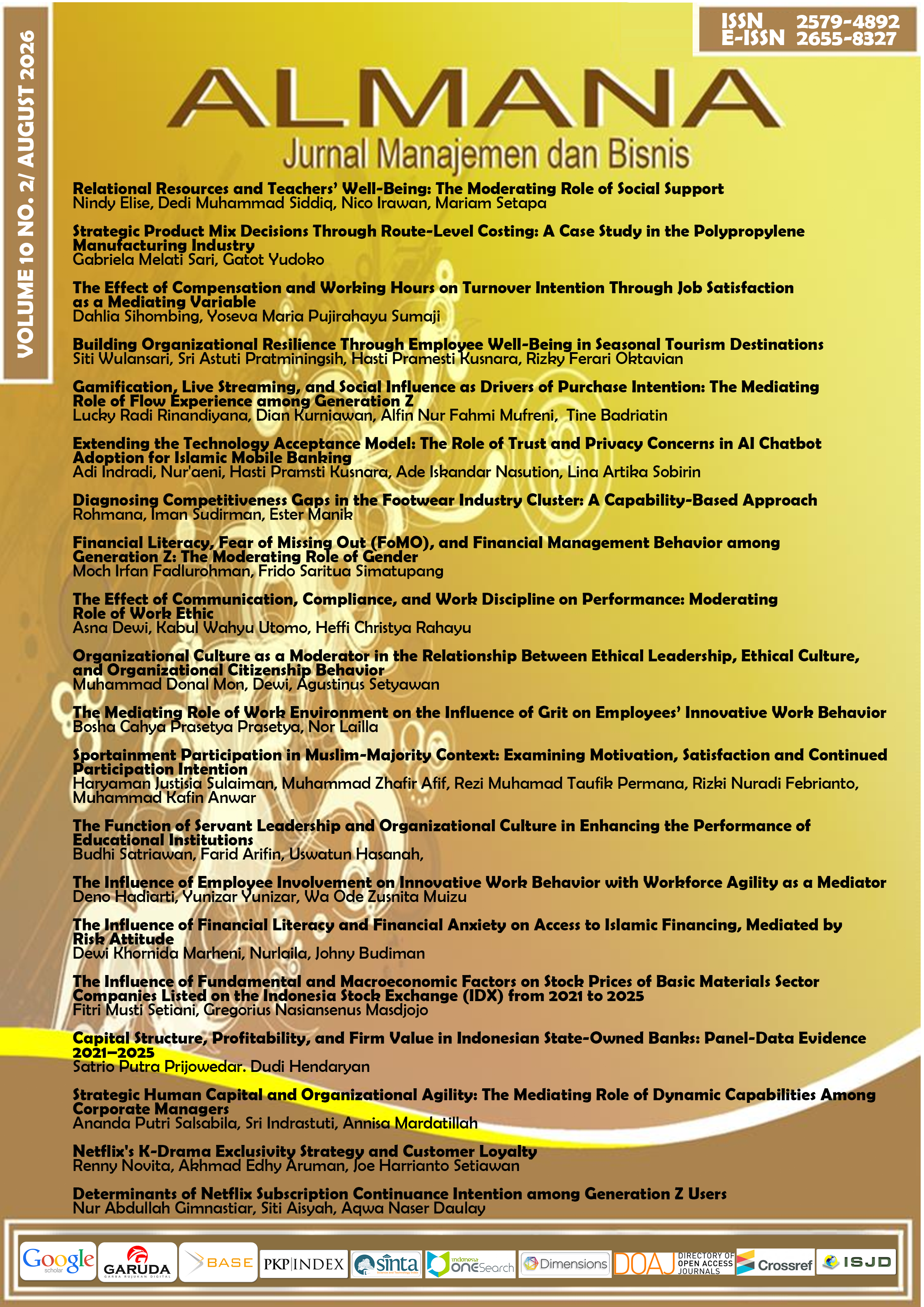
Strategic Product Mix Decisions Through Route-Level Costing: A Case Study in the Polypropylene Manufacturing Industry
DOI:
https://doi.org/10.36555/almana.v10i2.3037Keywords:
Activity-Based Costing, Bill of Material, Contribution Margin, Polypropylene Manufacturing , Product Mix DecisionsAbstract
Polypropylene manufacturers are impacted by volatile costs for raw materials (feedstocks), price competition from the marketplace, and their own plant capacities. As such, product mix decision-making is becoming increasingly reliant upon the accuracy of margins. This study was conducted to create a Route Level Costing Framework to aid in Margin-Informed Product Mix Planning within a Polypropylene Manufacturing Company. The methodology used for this research project involved a Quantitative Descriptive Case Study. Secondary Internal Data were collected from PT PRP, including Production Data, Grade-Formula-Route Mapping, Bill of materials (BOM) listings, Utility Consumption information, Costs and Selling Price Data. The developed framework will integrate both BOM-based cost calculations and Activity-Based Costing (ABC) Logic to Recalculate Production Costs at each Grade-Formula-Route combination. Additionally, it will compare the recalculated production cost with the Selling Price to determine Contribution Margin. The results indicate that grade-level costing may mask differences in costs and margins across different production routes. There exists a wide variation in Contribution Margin between the Current Costing Methodology and the proposed ABC-BOM Route-Level Cost Visibility framework. A total of 36 combinations of grades-formula-routes have been analyzed, and as a result there exist variations ranging from less than 1 USD/ton to greater than 17 USD/ton.
References
REFERENCES
Abeje, A. A., Abtew, M. A., Kasie, F. M., & Seid, B. A. (2025). Optimized model formulation through product mix scheduling for profit maximization in the apparel industry. Autex Research Journal, 25(1). https://doi.org/10.1515/aut-2024-0027
Attar, S. F., Mohammadi, M., & Pasandideh, S. H. R. (2025). A Bayesian network approach to production decisions by incorporating complex causal factors. Journal of Management Science and Engineering, 10(2). https://doi.org/10.1016/j.jmse.2025.03.002
Blazy, J., & Blazy, R. (2021). Polypropylene fiber reinforced concrete and its application in creating architectural forms of public spaces. Case Studies in Construction Materials, 14. https://doi.org/10.1016/j.cscm.2021.e00549
Correa, W., Ramirez, D., Bouferguene, A., & Al-Hussein, M. (2025). Building planning capacity in the offsite construction industry: introducing the theory of constraints for process optimization. Modular and Offsite Construction (MOC) Summit Proceedings. https://doi.org/10.29173/mocs315
Diaz-Sanchez, L., Retamozo-Shapiama, J., Ruiz-Garcia, N., Salas-Chaparin, A., Sinarahua-Cardenas, G., Ninaquispe-Soto, M., Riega-Virú, Y., Quezada-Hidalgo, E., & Salas-Riega, J. (2025). Optimization of net revenue in fruit wholesale distribution through a linear programming model. Procedia Computer Science, 257. https://doi.org/10.1016/j.procs.2025.03.156
Dragomir, M., Țîțu, A. M., Bodi, Ș., Oșanu, T., & Radu, A. (2024). Product development anxiety: A contingency planning model for innovative production companies. Sustainability, 16(14), Article 6251. https://doi.org/10.3390/su16146251
Genis, A. V. (2017). Analysis of the global and Russian markets of polypropylene and of its main consumption areas. Russian Journal of General Chemistry, 87(9). https://doi.org/10.1134/S1070363217090407
Ghareeb, A. E. M. (2024). The strategic use of six sigma to assess capacity planning in egyptian water companies as a competitive strategy. Corporate and Business Strategy Review, 5(2). https://doi.org/10.22495/cbsrv5i2art18
Gosselin, M. (2006). A review of activity-based costing: Technique, implementation, and consequences. In C. S. Chapman, A. G. Hopwood, & M. D. Shields (Eds.), Handbook of management accounting research (Vol. 2, pp. 641–671). Elsevier. https://doi.org/10.1016/S1751-3243(06)02008-6
Gutierrez, M. T. E., & Ermita, P. P. (2023). A model for product mix planning using multi-objective optimization approach with sensitivity analysis. International Journal of Innovation, Management and Technology, 14(4). https://doi.org/10.18178/ijimt.2023.14.4.952
Hartmann, G., Zerwas, T., Domröse, L., Boelsen, K., Hilger, C., & Schnürer, S. (2025). Product cost calculation in model-based systems engineering. systems, 13(5). https://doi.org/10.3390/systems13050373
Hossain, M. T., Shahid, M. A., Mahmud, N., Habib, A., Rana, M. M., Khan, S. A., & Hossain, M. D. (2024). Research and application of polypropylene: a review. In Discover Nano 19(1). https://doi.org/10.1186/s11671-023-03952-z
Ihenyen, C. J., & Michael, A. O. (2025). Cost volume profit (CVP) analysis: Application: Application and limitation in business planning. Journal of Public Administration and Social Welfare Research, 10(3), 103–110. https://doi.org/10.56201/jpaswr.v10.no3.2025.pg103.110
Kaplan, R. S., & Cooper, R. (1998). Cost & effect: Using integrated cost systems to drive profitability and performance. Harvard Business School Press.
Kennedy, H. (2024). Optimization. In Encyclopedia of Sport Management, Second Edition (pp. 673–674). Edward Elgar Publishing Ltd. https://doi.org/10.4337/9781035317189.ch392
Kotler, P., & Armstrong, G. (2018). Principles of marketing (17th ed.). Pearson.
Luo, D., Thevenin, S., & Dolgui, A. (2023). A state-of-the-art on production planning in Industry 4.0. In International Journal of Production Research (Vol. 61, Number 19). https://doi.org/10.1080/00207543.2022.2122622
Majka, M. (2024,). Competitive pricing: Staying ahead in a crowded market [Manuscript]. ResearchGate. https://www.researchgate.net/publication/386063409_Competitive_Pricing_Staying_Ahead_in_a_Crowded_Market
Mangngenre, S., Indah, A. B. R., Ikasary, D., Hamzi, A., & Novawanda, O. (2025). Assessment of production costs in toyota production system simulation based on makespan. Management and Production Engineering Review, 16(3). https://doi.org/10.24425/mper.2025.156146
Mudunuri, L. N. R., & Aragani, V. M. (2024). Bill of materials management: Ensuring production efficiency. International Journal of Intelligent Systems and Applications in Engineering, 12(23s), 1002–1012. https://www.ijisae.org/index.php/IJISAE/article/view/7102
Muanmeevit, C., & Pankham, S. (2025). A new online marketing mix strategy to unlock digital commerce success. International Journal of Advanced and Applied Sciences, 12(5). https://doi.org/10.21833/ijaas.2025.05.004
Nwaokete, D., Ince, C., Derogar, S., Nicolaides, D., & Ball, R. J. (2025). Environmental impact and sustainable development of pozzolanic concrete incorporating polypropylene fibers: A database study. Resources, Conservation and Recycling, 215. https://doi.org/10.1016/j.resconrec.2025.108142
Pasaribu, E. M. W., & Hasanuh, N. (2021). Effect of production costs and operational costs on net income. Journal of Economic, Bussines and Accounting (COSTING), 4(2), 731–740. https://doi.org/10.31539/costing.v4i2.1625
Pedersen, Z. P., & Williams, A. S. (2024). Marketing mix. In Encyclopedia of Sport Management, Second Edition (pp. 583–584). Edward Elgar Publishing Ltd. https://doi.org/10.4337/9781035317189.ch341
Putra, G. L., & Kitamura, M. (2023). Material cost minimization method of the ship structure considering material selection. Journal of Marine Science and Engineering, 11(3). https://doi.org/10.3390/jmse11030640
Shirolkar, Y. (2024). Optimization or prioritization - product mix decisions in sales and operations planning. International Journal of Science and Research (IJSR), 13(7), 827–831. https://doi.org/10.21275/sr24716034948
Downloads
Published
How to Cite
Issue
Section
Citation Check
License
Copyright (c) 2026 Almana : Jurnal Manajemen dan Bisnis

This work is licensed under a Creative Commons Attribution-NonCommercial-NoDerivatives 4.0 International License.