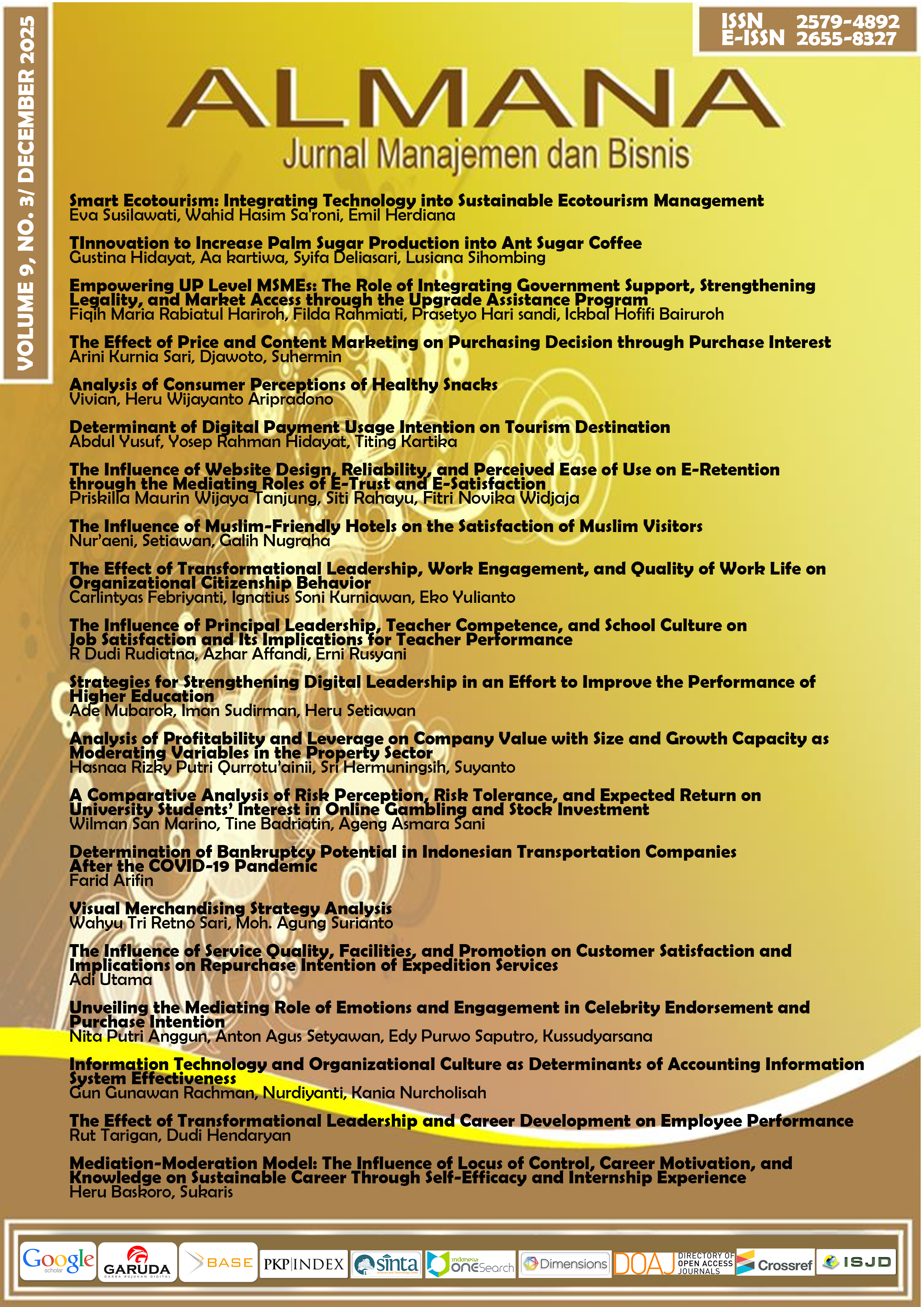
A Comparative Analysis of Risk Perception, Risk Tolerance, and Expected Return on University Students’ Interest in Online Gambling and Stock Investment
DOI:
https://doi.org/10.36555/almana.v9i3.2970Keywords:
Expected Return, Intention , Online Gambling, Risk Perception, Risk ToleranceAbstract
The growing participation of university students in both stock investment and online gambling raises concerns regarding how psychological factors shape financial decision-making. This study aims to examine and compare the effects of risk perception, risk tolerance, and return expectation on students’ investment decisions by distinguishing between students who invest exclusively in stocks and those who invest in stocks while engaging in online gambling. A quantitative research design was employed using Partial Least Squares Structural Equation Modelling (PLS-SEM) to assess the structural relationships among the variables, complemented by independent samples t-tests to evaluate intergroup differences at the indicator level. The findings indicate that return expectation, risk perception, and risk tolerance all exert positive and significant effects on investment decisions, with return expectation emerging as the strongest predictor. However, comparative results reveal that most indicators do not differ significantly between the two groups, except for specific risk perception indicators, suggesting lower risk perception among students involved in online gambling. These results support Prospect Theory, Dual Process Theory, and Cognitive Distortion models by highlighting the role of cognitive biases and risk underestimation in gambling-related behavior. In conclusion, the study underscores the importance of financial literacy programs that emphasize accurate risk perception and cognitive debiasing strategies to mitigate students’ vulnerability to speculative and gambling-related behaviors.
References
Ali, M., Al Munawar, R., Wiguna, S., Putri, A., Insani, N., Desyanti, I., Mario, M., Satrya, D., Aldi, M., Wijaya, R., & Rozak, A. (2024). Analisis Pola Perilaku dan Motivasi Bermain Judi Onilne Pada Mahasiswa di Era Digital. Analisis Pola Prilaku Dan Motivasi, 2(4), 62–69. https://doi.org/10.5281/zenodo.11104490
Badriatin, T., Rinandiyana, L. R., & Marino, W. S. (2022). Persepsi Risiko dan Sikap Toleransi Risiko terhadap Keputusan Investasi Mahasiswa. 20(2), 158–163.
Billieux, J., Schimmenti, A., Khazaal, Y., Maurage, P., & Heeren, A. (2020). Are we overpathologizing everyday life? A tenable blueprint for behavioral addiction research. Journal of Behavioral Addictions, 9(2), 356–370.
Binde, P., Romild, U., & Volberg, R. (2022). Forms of gambling, gambling involvement and risk behavior. Journal of Gambling Issues, 50, 1–21.
Breaban, A., & Noussair, C. N. (2021). Overconfidence and speculative trading. Journal of Behavioral Finance, 22(1), 1–15.
Canale, N., Vieno, A., Griffiths, M. D., Rubaltelli, E., & Santinello, M. (2022). Risk perception and problem gambling. Addictive Behaviors, 125, 107144.
Cindy Claudia, Efni Anita, & Nurlia Fusfita. (2023). Pengaruh Persepsi Risiko Dan Pengetahuan Mahasiswa Terhadap Minat Investasi Saham Syariah. Jurnal Ilmiah Manajemen, Ekonomi Dan Akuntansi, 3(2), 218–228. https://doi.org/10.55606/jurimea.v3i2.269
Elfahmi, R., Suherman, H., Nari, D., Permada, R., & Mardiati, D. (2021). The Affect of Students ’ Perceptions About Return , Risk and Operational Supervision on Student Investment Intentions in Agriculture. The 1st International …, 584(Icorsh 2020), 128–136. https://www.atlantis-press.com/article/125962414.pdf
Gainsbury, S. M., Abarbanel, B., & Blaszczynski, A. (2019). Intensification of gambling risk through digital platforms. Journal of Gambling Studies, 35(2), 509–525.
Giglio, S., Maggiori, M., Stroebel, J., & Utkus, S. (2021). Five facts about beliefs and portfolios. American Economic Review, 111(5), 1481–1522.
Hackethal, A., Jakusch, S. T., & Meyer, S. (2015). Taring All Investors With the Same Brush? Evidence for Heterogeneity in Individual Preferences From a Maximum Likelihood Approach. SSRN Electronic Journal. https://doi.org/10.2139/ssrn.2845866
Hair, J. F., Hult, G. T. M., Ringle, C. M., & Sarstedt, M. (2019). A Primer on Partial Least Squares Structural Equation Modeling (PLS-SEM) (2 (ed.)). SAGE Publications.
Hair, J. F., Hult, G. T. M., Ringle, C. M., Sarstedt, M., & Danks, N. P. (2021). PLS-SEM: An Introduction to Partial Least Squares Structural Equation Modeling. SAGE Publications.
Hing, N., Russell, A. M. T., King, D. L., & Gainsbury, S. (2021). Risk perception and gambling behavior in online environments. Journal of Behavioral Addictions, 10(3), 588–601.
Hoffmann, A. O. I., Post, T., & Pennings, J. M. E. (2020). Individual investor perceptions and behavior during market turbulence. Journal of Banking & Finance, 113, 105741.
Intansia Asari, & Heny Kurnianingsih. (2022). Analisis Faktor-Faktor Yang Mempengaruhi Minat Berinvestasi Generasi Milenial Di Surakarta. Jurnal Sinar Manajemen, 9(1), 66–74. https://doi.org/10.56338/jsm.v9i1.2327
Kaja, L. D., Angi, Y. F., & Tungga, C. (2023). Pengaruh Ekspektasi Return, Persepsi Risiko, Dan Self Efficacy Terhadap Minat Investasi Saham Pada Mahasiswa Program Studi Akuntansi Fakultas Ekonomi Dan Bisnis Universitas Nusa Cendana. Conference on Economic and Business Innovation, 26(35), 1573–1585.
Kanna, S., Siregar, A., & Romula Siregar, Q. (2024). Pengaruh Pengetahuan Investasi Dan Toleransi Risiko Terhadap Keputusan Investasi Dengan Minat Investasi Sebagai Variabel Intervening Pada Masyarakat Kecamatan Bandar Pulau. Balance: Jurnal Akuntansi Dan Manajemen, 3(2).
Kurniawan, P. I. (2021). Effect of Expected Return, Self Efficacy, and Perceived Risk on Investment Intention: An Empirical Study on Accounting Master Degree in Udayana University, Bali. Journal of Accounting Finance and Auditing Studies (JAFAS), 7(1), 40–55. https://doi.org/10.32602/jafas.2021.002
Lusardi, A., Michaud, P.-C., & Mitchell, O. S. (2021). Optimal financial literacy and saving for retirement. Journal of Political Economy, 129(2), 449–508.
Otoritas Jasa Keuangan. (2025). Siaran Pers : OJK Dorong Pemanfaatan Pasar Modal Oleh Generasi Muda di Wilayah Sumatera Barat , Sosialisasi Edukasi Pasar Modal Terpadu ( SEPMT ) 2025 di Padang.
PPATK. (2024). Jumlah Fantastis Usia Anak Main Judi Online.
Santoso, R. H., & Dewi, L. G. K. (2021). Pengaruh Dollar Cost Averaging, Persepsi Risiko, dan Bandwagon Effect terhadap Minat Berinvestasi Saham pada Mahasiswa S1 Akuntansi Undiksha. Repo.Undiksha.Ac.Id, 13(1), 2–3.
Sarstedt, M., Hair, J. F., Pick, M., Liengaard, B. D., Radomir, L., & Ringle, C. M. (2022). Progress in partial least squares structural equation modeling use in marketing research. Journal of the Academy of Marketing Science, 50(4), 1–23.
Slovic, P. (1987). Perception of risk. Science, 236(4799), 280–285.
Tempo. (2024). Mendiktisaintek Ungkap 960 Ribu Pelajar dan Mahasiswa Terdampak Judi Online. 1–11.
Yakovenko, I., Hodgins, D. C., Kim, H. S., & Wohl, M. J. (2018). The influence of gambling on risk perception. Journal of Gambling Studies, 34(1), 1–17.
Yuniartika, M. D. (2022). Pengaruh Pengetahuan Investasi, Teknologi Informasi Dan Modal Minimal Terhadap Minat Berinvestasi Di Platform Bibit Pada Mahasiswa. Universitas Lampung, 6(8.5.2017), 2003–2005.
Downloads
Published
How to Cite
Issue
Section
Citation Check
License
Copyright (c) 2025 Almana : Jurnal Manajemen dan Bisnis

This work is licensed under a Creative Commons Attribution-NonCommercial-NoDerivatives 4.0 International License.