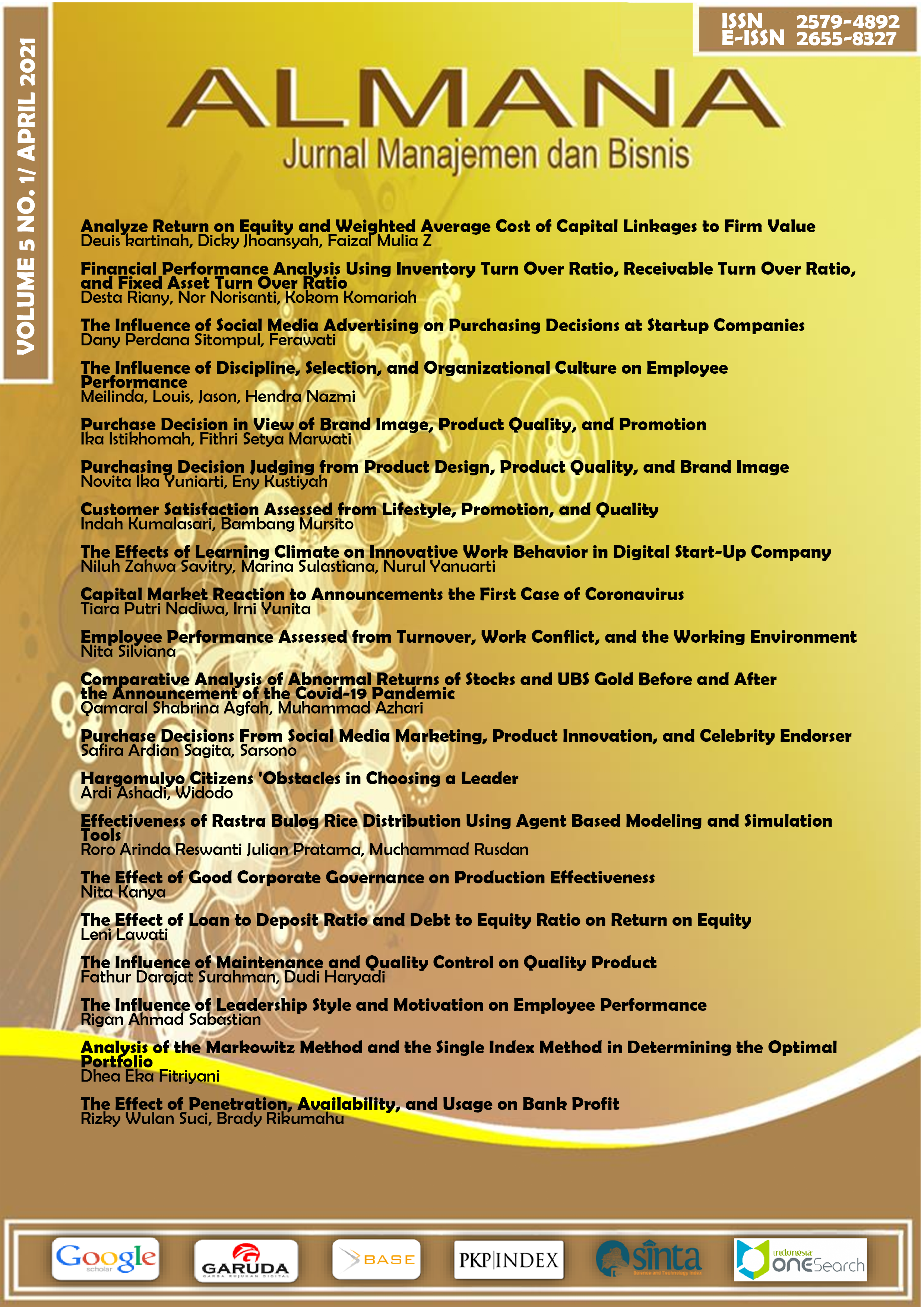
Employee Performance Assessed from Turnover, Work Conflict, and the Working Environment
DOI:
https://doi.org/10.36555/almana.v5i1.1538Keywords:
Employee Performance, Turnover, Work Conflict, Work EnvironmentAbstract
Turnover refers more to the maintenance level of tbsp. Work conflicts lead to the level of problems that occur within the scope of the company. The work environment describes the work atmosphere and the availability of facilities and infrastructure that can directly affect employee performance. The purpose of this study is to prove the results of employee performance in terms of turnover, work conflict, and the work environment of PT. Kinarya Tunas Artha. Using descriptive and quantitative research types. Total population 200 respondents, sample 67 respondents, using multiple linear regression analysis. Research results: f test describes turnover, work conflict & work environment affect employee performance. While the t-test states that turnover has a positive & significant effect, work conflict has a negative and significant effect, the work environment has a positive and significant effect on employee performance. The results obtained R2/ coefficient of determination of the effect of turnover, work conflict, and work environment on the performance of 53.5%, the work environment variable becomes dominant because the tcount is the largest.
References
AlBattat, A. R., Som, A. P. M., & Helalat, A. S. (2013). Overcoming Staff Turnover in the Hospitality Industry using Mobley’s Model. International Journal of Learning and Development. https://doi.org/10.5296/ijld.v3i6.4844
Asmara, A. P. (2018). Pengaruh Turnover Intention terhadap Kinerja Karyawan di Rumah Sakit Bedah Surabaya. Jurnal Administrasi Kesehatan Indonesia. https://doi.org/10.20473/jaki.v5i2.2017.123-129
Fallis, A. ., Robbins, S. P., & Judge, T. (2014). Organizational Behaviour, Global Edition. In Journal of Chemical Information and Modeling.
Hasibuan, M. S. P. (2011). Manajemen Sumber Daya Manusia. Edisi Revisi Jakarta: Bumi Aksara.
Indrasari, M. (2017). Kepuasan Kerja dan Kinerja Karyawan. Yogyakarta: Indomedia Pustaka, 2017.
Mangkunegara, Anwar Prabu. (2017). Manajemen Sumber Daya Manusia Perusahaan. Bandung: PT. In Remaja Rosdakarya.
Pramudia, A., Samdin, Yusuf, Budi, N., Mokodompit, E. A., & Ramdhani, F. (2019). Pengaruh Beban Kerja dan Konflik Kerja Terhadap Kinerja Karyawan Pada Bank Syariah Mandiri Cabang Kendari. Jurnal Manajemen & Kewirausahaan.
Rivai, Veitzhal. (2013). Manajemen Sumber Daya Manusia. Manajemen Sumber Daya Manusia Untuk Perusahaan Dari Teori Ke Praktik.
Robbins, S. P., & Judge, T. A. (2008). Perilaku Organisasi Jilid II. Salemba Empat.
Sedarmayanti. (2016). Manajemen Sumber Daya Manusia Reformasi Birokrasi Dan Manajemen Pegawai Negeri
Sipil. Bandung: PT. Refika Aditama. In Refika Aditama.
Sulisvi, S., Kustiyah, E., & Widayanti, R. (2019). Analisis Pengaruh Konflik Peran Ganda, Disiplin Kerja, dan Lingkungan Kerja Terhadap Kinerja Karyawan PT. Global Indo Intimates Di Klaten. Jurnal Ilmiah Edunomika. https://Doi.Org/10.29040/Jie.V3i02.661
Utami, P. D. P., & Rahyuda, K. (2019). The antecedents of consumers’ attitude and its consequences on online purchase intention. International Research Journal of Management, IT and Social Sciences. https://doi.org/10.21744/irjmis.v6n4.663