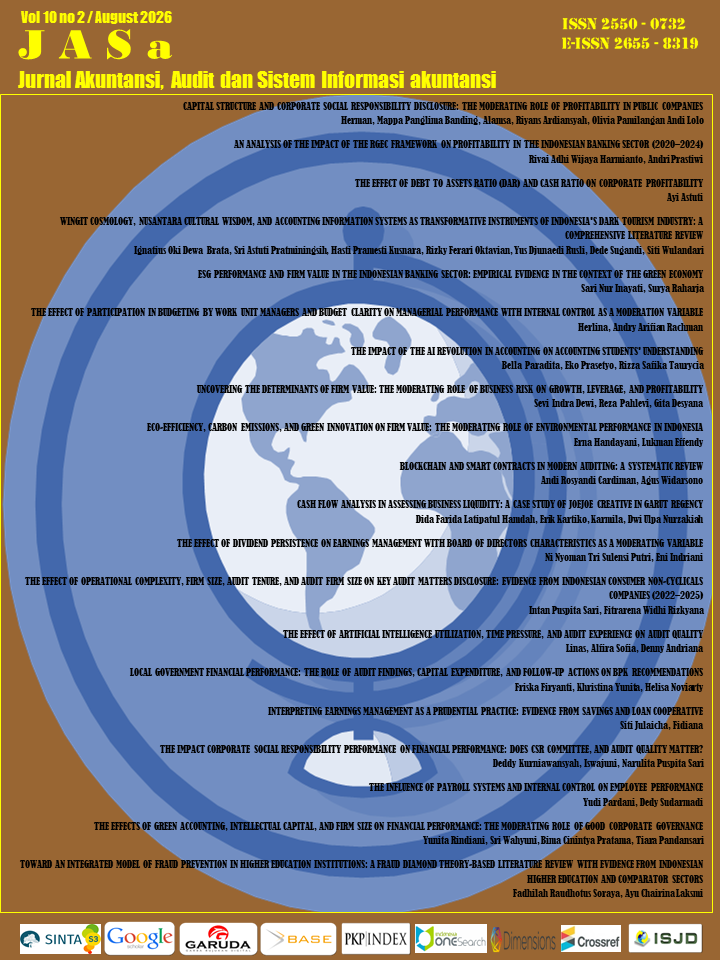
Interpreting Earnings Management as A Prudential Practice: Evidence from Savings and Loan Cooperative
DOI:
https://doi.org/10.36555/jasa.v10i2.3079Keywords:
Accounting Discretion, Earnings Management, Financial Sustainability, Member Welfare, Savings and Loan CooperativeAbstract
Earnings management has predominantly been examined in profit-oriented organizations, while its meaning and practice in savings and loan cooperatives remain relatively underexplored. Unlike investor-owned firms, cooperatives are member-oriented organizations in which Surplus of Cooperative Operations (Sisa Hasil Usaha/SHU) functions not only as an indicator of financial performance but also as a mechanism for distributing economic benefits to members. This study aims to understand how earnings management is interpreted and practiced by managers and board members of savings and loan cooperatives, particularly in relation to accounting discretion, members’ interests, SHU distribution, and stewardship. The study employs a qualitative approach using a case study design. Data were collected through in-depth interviews with six informants from two savings and loan cooperatives, referred to as Cooperative A and Cooperative B, and analyzed using thematic analysis with the support of NVivo. The findings indicate that earnings management is not necessarily perceived as opportunistic manipulation but may be understood as responsible accounting discretion, particularly in managing member receivables, establishing loan loss provisions, and recognizing revenue. Such discretion is closely associated with stewardship responsibilities, accountability to members, financial prudence, and cooperative sustainability. Differences between the two cooperatives further demonstrate that accounting discretion is shaped by organizational context and considerations regarding SHU distribution and members’ welfare. The study recommends strengthening transparency and accountability in cooperative financial reporting and governance to ensure that accounting discretion remains aligned with members’ interests, prudent financial management, and long-term cooperative sustainability.
References
Almutairi, A. R. (2021). Earnings management and the role of MOSAL in co-ops. Journal of Co-operative Organization and Management, 9(1), 100131. https://doi.org/10.1016/j.jcom.2021.100131
Aspers, P., & Corte, U. (2019). What is qualitative in qualitative research. Qualitative Sociology, 42(2), 139–160. https://doi.org/10.1007/s11133-019-9413-7
Braun, V., & Clarke, V. (2006). Using thematic analysis in psychology. Qualitative Research in Psychology, 3(2), 77–101. https://doi.org/10.1191/1478088706qp063oa
Braun, V., & Clarke, V. (2021). One size fits all? What counts as quality practice in (reflexive) thematic analysis? Qualitative Research in Psychology, 18(3), 328–352. https://doi.org/10.1080/14780887.2020.1769238
Bryer, R. A. (2011). Accounting as a social practice: The case of worker cooperatives. Accounting, Organizations and Society, 36(8), 478–493. https://doi.org/10.1016/j.aos.2011.09.002
Byrne, D. (2022). A worked example of Braun and Clarke’s approach to reflexive thematic analysis. Quality & Quantity, 56(3), 1391–1412. https://doi.org/10.1007/s11135-021-01182-y
Creswell, J. W., & Poth, C. N. (2018). Qualitative inquiry and research design: Choosing among five approaches (4th ed.). SAGE Publications.
Davis, J. H., Schoorman, F. D., & Donaldson, L. (1997). Toward a stewardship theory of management. Academy of Management Review, 22(1), 20–47. https://doi.org/10.5465/amr.1997.9707180258
Dekrita, Y. A., Sanga, K. P., & Cici, S. E. N. (2025). Pendampingan Rapat Anggota Tahunan KSP Kopdit Obor Mas. JPMNT: Jurnal Pengabdian Masyarakat Nian Tana, 3(3), 187–194. https://doi.org/10.59603/jpmnt.v3i3.1037
Freeman, R. E. (1984). Strategic management: A stakeholder approach. Pitman.
Freeman, R. E., Harrison, J. S., Wicks, A. C., Parmar, B. L., & de Colle, S. (2010). Stakeholder theory: The state of the art. Cambridge University Press.
Healy, P. M., & Wahlen, J. M. (1999). A review of the earnings management literature and its implications for standard setting. Accounting Horizons, 13(4), 365–383. https://doi.org/10.2308/acch.1999.13.4.365
Jensen, M. C., & Meckling, W. H. (1976). Theory of the firm: Managerial behavior, agency costs and ownership structure. Journal of Financial Economics, 3(4), 305–360. https://doi.org/10.1016/0304-405X(76)90026-X
Lado, B. Y., Oematan, H. M., & Tefa, S. G. (2025). Analisis kredit macet terhadap kinerja keuangan Koperasi Simpan Pinjam Swasti Sari Cabang Kota Kupang. Jurnal Kendali Akuntansi, 3(1), 89–94. https://doi.org/10.59581/jka-widyakarya.v3i1.4717
Maia, S. C., Bressan, V. G. F., Lamounier, W. M., & Braga, M. J. (2013). Earnings management in Brazilian credit unions. Brazilian Business Review, 10(4), 91–109. https://doi.org/10.15728/bbr.2013.10.4.4
Savira, F., & Januarti, I. (2020). Akuntabilitas koperasi simpan pinjam di Jawa Tengah. Jurnal Ekonomi dan Bisnis, 23(1), 97–112. https://doi.org/10.24914/jeb.v23i1.2775
Scott, W. R. (2015). Financial accounting theory (7th ed.). Pearson.
Subadriyah, S., Sa'diyah, M., & Khusnah, H. (2020). Praktik manajemen laba: Sebuah kajian studi hermeneutika. Jurnal Ekonomi dan Bisnis, 23(2), 225–242. https://doi.org/10.24914/jeb.v23i2.2129
Turi, E. M., & Muharram, H. (2023). Pengaruh transparansi dan akuntabilitas laporan keuangan koperasi terhadap tingkat kepercayaan anggota koperasi. Jurnal Economina, 2(12), 3787–3797. https://doi.org/10.55681/economina.v2i12.1103
Watts, R. L., & Zimmerman, J. L. (1986). Positive accounting theory. Prentice-Hall.
Yin, R. K. (2018). Case study research and applications: Design and methods (6th ed.). SAGE Publications.
Downloads
Published
How to Cite
Issue
Section
Citation Check
License
Copyright (c) 2026 JASa (Jurnal Akuntansi, Audit dan Sistem Informasi Akuntansi)

This work is licensed under a Creative Commons Attribution-NonCommercial-NoDerivatives 4.0 International License.