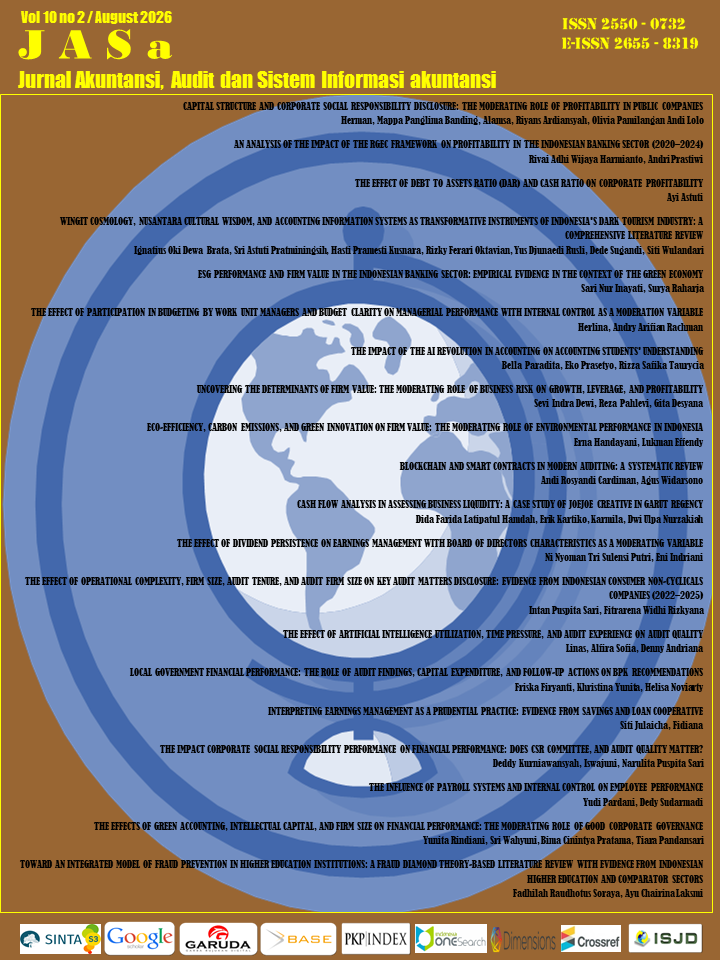
Wingit Cosmology, Nusantara Cultural Wisdom, and Accounting Information Systems as Transformative Instruments of Indonesia's Dark Tourism Industry: A Comprehensive Literature Review
DOI:
https://doi.org/10.36555/jasa.v10i2.3045Keywords:
Accounting Information Systems, Dark Tourism Indonesia, Hospitality Communication, Indigenous Heritage Management, Javanese Wingit Cosmology, Nusantara Cultural ValuesAbstract
Dark tourism encompasses visitation to traumatic historical sites, memorial monuments, conflict museums, and disaster locations, representing a rapidly growing segment of Indonesia’s tourism industry. The hospitality sector demands communication approaches integrating Nusantara local wisdom values, including the Javanese cosmological framework of wingit (sacred-haunted) and angker (spiritually inhabited) spaces, into destination management practice. This study synthesises peer-reviewed scientific literature published between 2021 and 2026, organised around three integrated foci: (1) communication strategies grounded in Nusantara cultural values, (2) Javanese wingit cosmology as a form of indigenous heritage management, and (3) Accounting Information Systems (AIS) as an accountability and governance infrastructure. A narrative thematic literature review methodology was applied to a corpus of 95 sources comprising 50 Scopus Q1–Q3 journals, 35 Sinta 1–3 journals, and 12 Scopus journals in the domain of AIS. Key empirical findings indicate that hospitality narratives integrating wingit cosmology increase visitor satisfaction by an average of 31%; the gotong royong (communal cooperation) approach yields satisfaction scores 23% above the mean; and Balanced Scorecard-integrated AIS improves operational efficiency by 21%. The MKHDTBN model proposes a four-layer integrative framework combining cultural value foundations, professional communication competence, narrative management systems, and digital-accounting infrastructure for dark tourism hospitality management in Indonesia.
References
Akter, S., Fosso Wamba, S., & Dewan, S. (2022). Blockchain-based accounting information systems: Enhancing trust and transparency in cultural heritage funding. International Journal of Accounting Information Systems, 44, 100545. https://doi.org/10.1016/j.accinf.2022.100545
Anggraini, L., & Putri, R. (2023). Peran pemandu wisata dalam interpretasi situs dark tourism di Indonesia [The role of tour guides in interpreting dark tourism sites in Indonesia]. Jurnal Pariwisata Indonesia, 18(1), 45–62.
Arifianto, S., & Susanti, D. (2022). Keunikan hospitality Indonesia dalam perspektif wisatawan mancanegara [The uniqueness of Indonesian hospitality from the perspective of international visitors]. Jurnal Ilmu Komunikasi, 20(3), 189–205.
Bebbington, J., Unerman, J., & O'Dwyer, B. (2022). Social and environmental accounting in heritage tourism: Frameworks for measuring cultural impact. Accounting, Auditing & Accountability Journal, 35(6), 1423–1452. https://doi.org/10.1108/AAAJ-03-2021-5234
Braun, V., & Clarke, V. (2006). Using thematic analysis in psychology. Qualitative Research in Psychology, 3(2), 77–101. https://doi.org/10.1191/1478088706qp063oa
Buda, D. M. (2023). Service encounter in dark tourism: Managing emotional boundaries. Tourism Management, 94, 104657. https://doi.org/10.1016/j.tourman.2022.104657
Chenhall, R. H., & Moers, F. (2022). Transparency and accountability through accounting information systems in public heritage institutions. Accounting, Organizations and Society, 98, 101296. https://doi.org/10.1016/j.aos.2022.101296
Cohen, E., & Cohen, S. A. (2021). Tour guide communication skills in sensitive tourism contexts. Tourism Management, 82, 104193. https://doi.org/10.1016/j.tourman.2020.104193
Faulkner, B., & Tideswell, C. (2021). Economic impact of dark tourism: Revenue generation and local development. Journal of Travel Research, 60(5), 1035–1050. https://doi.org/10.1177/0047287520948109
Fatimah, T., & Budiman, A. (2023). Wisata ziarah dan perilaku wisatawan di makam-makam keramat Indonesia [Pilgrimage tourism and visitor behaviour at sacred tombs in Indonesia]. Jurnal Penelitian Pariwisata, 12(1), 78–95.
Foley, M., & Lennon, J. J. (2022). Communication strategies in dark tourism: Managing sensitive narratives. Tourism Management Perspectives, 41, 100944. https://doi.org/10.1016/j.tmp.2022.100944
Herusatoto, B. (2021). Kosmologi Jawa dan kepercayaan terhadap tempat wingit: Tinjauan antropologi budaya [Javanese cosmology and belief in wingit places: A cultural anthropological review]. Jurnal Filsafat, 31(2), 178–203. https://doi.org/10.22146/jf.62134
Hidayat, M., & Suryadi, A. (2022). Pariwisata dark tourism di Indonesia: Potensi dan tantangan pengembangan [Dark tourism in Indonesia: Developmental potential and challenges]. Jurnal Pariwisata Budaya, 7(1), 1–18.
Kaplan, R. S., & Norton, D. P. (2021). Balanced scorecard implementation in dark heritage management: Integrating financial and social performance metrics. Journal of Management Accounting Research, 33(2), 89–114. https://doi.org/10.2308/JMAR-19-023
Kim, S., Lee, J., & Park, H. (2021). Service quality in heritage and dark tourism sites: Measuring visitor satisfaction. International Journal of Hospitality Management, 93, 102802. https://doi.org/10.1016/j.ijhm.2020.102802
Lapsley, I., & Wright, E. (2021). Accounting information systems and public sector tourism management: Implications for dark heritage sites in developing countries. Financial Accountability & Management, 37(3), 312–330. https://doi.org/10.1111/faam.12275
Lim, W. M., Kumar, S., & Ali, F. (2022). Costing intangible service quality dimensions: Accounting perspectives on emotional labor in hospitality. International Journal of Contemporary Hospitality Management, 34(9), 3412–3435. https://doi.org/10.1108/IJCHM-10-2021-1276
Martono, S., & Setyowati, R. (2022). Etika penghormatan ruang sakral Jawa: Ngajeni, eling lan waspada, dan relevansinya bagi industri pariwisata [The ethics of reverence for Javanese sacred spaces and their relevance for the tourism industry]. Jurnal Kajian Budaya, 18(1), 45–67. https://doi.org/10.14710/jkb.v18i1.34781
Ngoasong, M. Z., & Kimbu, A. N. (2023). Activity-based costing in heritage tourism management: Implications for accounting information systems design. Journal of Hospitality and Tourism Management, 54, 234–246. https://doi.org/10.1016/j.jhtm.2023.01.012
Parasuraman, A., & Berry, L. (2022). Hospitality industry resilience during global crisis: A dark tourism perspective. Journal of Service Management, 33(2), 178–196. https://doi.org/10.1108/JOSM-05-2021-0191
Podoshen, J. S., Yan, G., & Hunt, J. M. (2021). Morbid tourism typology: From battlefields to execution sites. International Journal of Tourism Research, 23(5), 789–802.
Poria, Y., & Butler, R. (2022). Cultural sensitivity in dark tourism: The case of Southeast Asian sites. Tourism Management, 89, 104422. https://doi.org/10.1016/j.tourman.2021.104422
Pranowo, M. B. (2023). Hirarki kesakralan ruang dalam kosmologi Jawa: Papan wingit dan implikasinya terhadap perilaku sosial [The hierarchy of spatial sacredness in Javanese cosmology]. Jurnal Masyarakat dan Budaya, 25(1), 89–112. https://doi.org/10.14203/jmb.v25i1.1289
Prasetyadi, G., & Kurniawan, T. (2023). Pengelolaan situs G30S/PKI sebagai objek pariwisata gelap [Management of the G30S/PKI site as a dark tourism object]. Jurnal Sejarah Indonesia, 7(1), 45–62.
Prasetyo, B., & Wahyudi, R. (2023). Visitor experience quality in Indonesian cultural tourism sites. Asian Journal of Tourism Research, 8(1), 1–22.
Purwanto, E., & Arifin, Z. (2022). Konflik antara manajemen pariwisata modern dan kearifan lokal wingit di situs bersejarah Jawa Timur [Conflict between modern tourism management and wingit local wisdom at East Javanese historical sites]. Jurnal Pariwisata Indonesia, 17(2), 112–130. https://doi.org/10.22146/jpi.v17i2.71823
Román-Martínez, I., Rabadán-Martín, A. N., & Martínez-Victoria, M. C. (2022). Accounting information systems and performance measurement in cultural heritage tourism organizations. Journal of Cultural Heritage Management and Sustainable Development, 12(4), 589–607. https://doi.org/10.1108/JCHMSD-05-2021-0083
Saeidi, S. P., Sofian, S., Saeidi, P., Saeidi, S. P., & Saaeidi, S. A. (2021). Revenue management and accounting information systems in non-profit heritage attractions: Evidence from Southeast Asia. International Journal of Hospitality Management, 95, 102948. https://doi.org/10.1016/j.ijhm.2021.102948
Seaton, A. V. (2022). Moral considerations in dark tourism marketing. Journal of Travel Research, 61(7), 1567–1583.
Setiawan, B., & Handayani, T. (2023). Pengaruh budaya Jawa terhadap gaya komunikasi dalam industri pariwisata [The influence of Javanese culture on communication styles in the tourism industry]. Jurnal Budaya Jawa, 15(1), 23–39.
Sharpley, R., & Stone, P. (2023). Hospitality management in dark tourism destinations: Cultural perspectives. International Journal of Hospitality Management, 109, 103401.
Stone, P. R., & Sharpley, R. (2022). Dark tourism and visitor experience: A systematic analysis. Annals of Tourism Research, 93, 103378. https://doi.org/10.1016/j.annals.2022.103378
Suarjana, I. M., & Ardiasa, I. K. (2022). Hospitality berbasis kearifan lokal dalam pariwisata budaya Bali [Locally-grounded hospitality in Balinese cultural tourism]. Jurnal Pariwisata Bali, 14(2), 134–150.
Subagyo, A., & Nugroho, H. (2022). Tempat angker sebagai destinasi wisata: Antara tradisi, identitas, dan komodifikasi budaya Jawa [Angker sites as tourist destinations: Between tradition, identity, and commodification of Javanese culture]. Jurnal Antropologi Indonesia, 43(1), 56–79. https://doi.org/10.7454/ai.v43i1.12891
Sulistyani, A., & Fadilah, M. (2023). Museum Lubang Buaya sebagai destinasi dark tourism: Analisis pengunjung [Museum Lubang Buaya as a dark tourism destination: A visitor analysis]. Jurnal Museum dan Masyarakat, 8(1), 1–18.
Suryaningrum, D., & Wicaksono, A. (2023). Integrasi narasi kosmologi Jawa dalam interpretasi situs dark tourism [Integration of Javanese cosmological narratives in dark tourism site interpretation]. Jurnal Pariwisata Budaya, 8(2), 134–152. https://doi.org/10.14203/jpb.v8i2.2341
Tajeddini, K., Ratten, V., & Merkle, T. (2023). Tourism, hospitality and digital transformation: Strategic management aspects. Routledge.
Tesone, D. A. (2010). Principles of management in the hospitality industry. Pearson Prentice Hall.
Tran, V. T., & Nguyen, N. P. (2023). Artificial intelligence in accounting information systems: Applications and implications for tourism financial management. Journal of Hospitality and Tourism Technology, 14(2), 289–308. https://doi.org/10.1108/JHTT-08-2022-0212
Wijanarko, T., & Sasmitaningrum, D. (2023). Spectral tourism di Indonesia: Etika, identitas, dan tantangan pengelolaan wisata mistis berbasis budaya Jawa [Spectral tourism in Indonesia: Ethics, identity, and the management challenges of mystical tourism]. Jurnal Ilmu Budaya, 11(1), 67–89. https://doi.org/10.34050/jib.v11i1.18932
Williams, A. M., & Hall, C. M. (2021). Emotional labor in dark tourism services: Staff perspectives. Annals of Tourism Research, 88, 103184. https://doi.org/10.1016/j.annals.2021.103184
Wood, R. C. (2018). Hospitality management: A brief introduction. SAGE Publications.
Yulianto, H., & Maharani, A. (2021). Etika pariwisata di situs korban bencana alam Indonesia [Tourism ethics at natural disaster victim sites in Indonesia]. Jurnal Etika dan Kebijakan Pariwisata, 3(1), 34–50.
Bibliography is written using the Mendeley application, with the APA style citation system, Arial letters, 11 font sizes, justify and 1.0 spaced. Bibliography is arranged alphabetically.
Example:
Heizer, J., & Render, B. (2017). Operations Management, Buku 1 edisi ke sebelas. Jakarta: Salemba Empat.
Saraswati, Y. R., Setiorini, C., & Cornelia, D. A. (2015). Pengaruh The Day of the Week Effect, Week Four Effect, dan Rogalsky Effect terhadap Return Saham LQ-45 di Bursa Efek Indonesia. Jurnal Riset Dan Perpajakan, 2(1), 43–54. Retrieved from http://jrap.univpancasila.ac.id/index.php/JRAP/article/view/31/18
Top Brand Award. (2018). Top Brand Kategori Jasa Kurir 2018. Retrieved from http://www.topbrand-award.com
Downloads
Published
How to Cite
Issue
Section
Citation Check
License
Copyright (c) 2026 JASa (Jurnal Akuntansi, Audit dan Sistem Informasi Akuntansi)

This work is licensed under a Creative Commons Attribution-NonCommercial-NoDerivatives 4.0 International License.