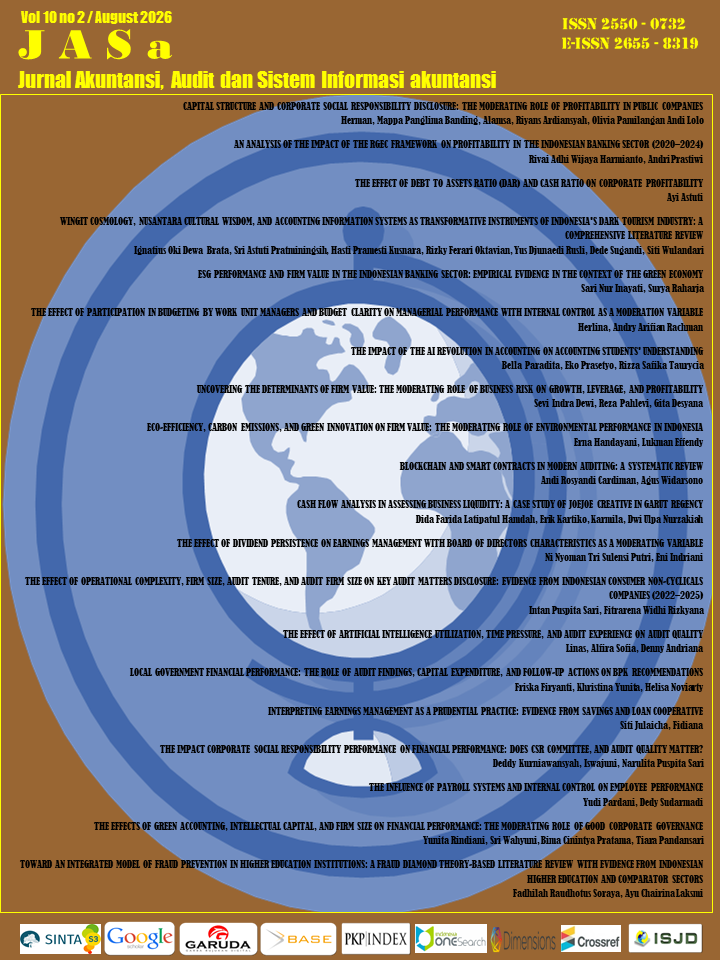
An Analysis of the Impact of the RGEC Framework on Profitability in the Indonesian Banking Sector (2020–2024)
DOI:
https://doi.org/10.36555/jasa.v10i2.3033Keywords:
Banking Profitability, Return on Assets, Non-Performing Loans, Operational Efficiency, Capital AdequaAbstract
This study aims to analyze the impact of the RGEC framework (Risk Profile, Good Corporate Governance, Earnings, and Capital) on banking profitability in Indonesia, proxied by Return on Assets (ROA). The population consists of all banks operating in Indonesia, with a purposive sampling technique resulting in 230 observations over the 2020–2024 period. A quantitative approach is employed using multiple linear regression based on panel data. In addition, classical assumption tests—including multicollinearity, heteroskedasticity, autocorrelation, normality, and cross-section dependence—are conducted to ensure the validity of the model. The results indicate that BOPO, as a proxy for operational efficiency, and CAR, representing capital adequacy, have a significant effect on ROA. In contrast, NPL, LDR, NIM, and GCG do not show statistically significant effects on profitability. However, the findings also reveal violations of classical assumptions, particularly heteroskedasticity, autocorrelation, and cross-sectional dependence, which may lead to biased estimates if not properly addressed. Therefore, the application of robust estimation techniques, such as Driscoll–Kraay standard errors, is necessary to improve the reliability and accuracy of the results. In conclusion, operational efficiency and capital structure emerge as the primary determinants of banking profitability, while the choice of appropriate estimation methods plays a crucial role in ensuring valid empirical findings in panel data analysis.
References
Anggari, N. L. S., & Dana, I. M. (2020). The Effect of Capital Adequacy Ratio, Third Party Funds, Loan to Deposit Ratio, Bank Size on Profitability in Banking Companies on IDX. AJHSSR, 4(12), 334–338.
Bueno, L. A. (2024). Impacts of Digitization on Operational Efficiency in Banking. International Journal of Information Management Data Insights, 4(1), 100230. https://doi.org/10.1016/j.jjimei.2024.100230
Dasilas, A., & Karanović, G. (2025). The Impact of FinTech Firms on Bank Performance: Evidence from the UK. EuroMed Journal of Business, 20(1), 244–258. https://doi.org/10.1108/EMJB-04-2023-0099
Dsouza, S., Rabbani, M. R., Hawaldar, I. T., & Jain, A. K. (2022). Impact of Bank Efficiency on Profitability in India. International Journal of Financial Studies, 10(4), 93. https://doi.org/10.3390/ijfs10040093
Financial Services Authority (OJK). (2025). Indonesian Banking Performance Report – June 2025. https://www.ojk.go.id
Karim, R. (2022). Non-Performing Loans and Bank Profitability: Evidence from Bangladesh. International Journal of Finance & Banking Studies, 11(4), 95–107. https://doi.org/10.20525/ijfbs.v11i4.2314
Madugu, A. H., Ibrahim, M., & Amoah, J. O. (2020). Differential Effects of Credit Risk and Capital Adequacy Ratio on Profitability of the Domestic Banking Sector in Ghana. Transnational Corporations Review, 12(1), 37–52. https://doi.org/10.1080/19186444.2019.1704582
Marsifa, G., Gursida, H., & Indrayono, Y. (2025). Profitability as a Moderator in the Effect of RGEC-Based Banking Health on Firm Value: Evidence from IDX-Listed Banks (2019–2023). International Journal of Accounting, Business and Organization (IJABO), 6(3). https://doi.org/10.61242/ijabo.25.545
Martinek, W. L. (2017). A Review of Textbooks for Teaching Graduate Research Methods. PS: Political Science & Politics, 50(2), 554–558.
Maulida, S., & Firdaus, A. (2025). Development of Islamic Bank Performance Measurement Using the Maslahah Performa (MaP) Approach. ISLAMICONOMIC: Jurnal Ekonomi Islam. https://www.journal.islamiconomic.or.id
Mirović, V., Kalaš, B., Milenković, N., Andrašić, J., & DJaković, M. (2024). Modelling Profitability Determinants in the Banking Sector: The Case of the Eurozone. Mathematics, 12(6), 897. https://doi.org/10.3390/math12060897
Nguyen, P. D. (2024). Non-Performing Loans and Bank Profitability: Evidence from Vietnam. Macroeconomics and Finance in Emerging Market Economies, 18(2), 399–419. https://doi.org/10.1080/17520843.2024.2318927
Ozili, P. K., & Arun, T. G. (2023). Does Economic Policy Uncertainty Affect Bank Profitability? International Journal of Managerial Finance, 19(4), 803–830. https://doi.org/10.1108/IJMF-04-2022-0177
Sajoga, E. (2025). Resilience and Innovation: Analyzing Permata Bank’s Financial Performance and Business Strategy Amid Digital Disruption and Market Volatility [Graduate Thesis, IPMI Institute]. http://repository.ipmi.ac.id/id/eprint/2855
Sawasemiariat, M. Y., & Setya Wati, C. H. (2025). The Effect of Non-Performing Loans and Loan to Deposit Ratio on Profitability. Management Economics Journal (MEJ), 1(1). https://doi.org/10.63185/mej.v1i1.2
Shanmugalingam, P. (2023). Does E-commerce Matter on International Trade of Asian Countries. PLOS ONE, 18(4), e0284503. https://doi.org/10.1371/journal.pone.0284503
Silvan, A. (2025). Analysis of Liquidity, Solvency, and Profitability Ratios to Assess the Financial Health of PT. Bank Central Asia, Tbk Jakarta. Devotion: Journal of Community Research, 6(11). https://doi.org/10.59188/devotion.v6i11.25597
Syafrizal, A., Ilham, R. N., Muchtar, D., & Wardhiah. (2023). Effect of Capital Adequacy Ratio, Non Performing Financing, Financing to Deposit Ratio, Operating Expenses and Operational Income on Profitability at PT. Bank Aceh Syariah. JARUDA, 1(4). https://doi.org/10.54443/jaruda.v1i4.51
Tashkandi, A. A. (2023). Shariah Supervision and Bank Performance. Journal of Business and Socio-Economic Development, 3(3), 253–264. https://doi.org/10.1108/JBSED-02-2022-0024
Tomak, S., & Yılmaz, K. (2025). Bank Performance of State, Private, and Foreign Owned Banks in Türkiye. International Journal of Economics and Financial Issues, 15(3), 99–109. https://doi.org/10.32479/ijefi.19046
Uddin, M. K. (2022). Effect of Leverage and CAR on Profitability. European Journal of Business and Management Research, 7(3). https://doi.org/10.24018/ejbmr.2022.7.3.1463
Wahyuni, A., & Ompusunggu, H. (2025). Analisis Faktor-Faktor yang Mempengaruhi Profitabilitas Bank Perekonomian Rakyat. EKOBISTEK, 14(1). https://doi.org/10.35134/ekobistek.v14i1.871
Yuan, D., Gazi, M. A. I., Harymawan, I., Dhar, B. K., & Hossain, A. I. (2022). Profitability Determining Factors of Banking Sector. Frontiers in Psychology, 13. https://doi.org/10.3389/fpsyg.2022.1000412
Downloads
Published
How to Cite
Issue
Section
Citation Check
License
Copyright (c) 2026 JASa (Jurnal Akuntansi, Audit dan Sistem Informasi Akuntansi)

This work is licensed under a Creative Commons Attribution-NonCommercial-NoDerivatives 4.0 International License.